Define the boundary for Selection Criteria in Artificial-Turf Planning
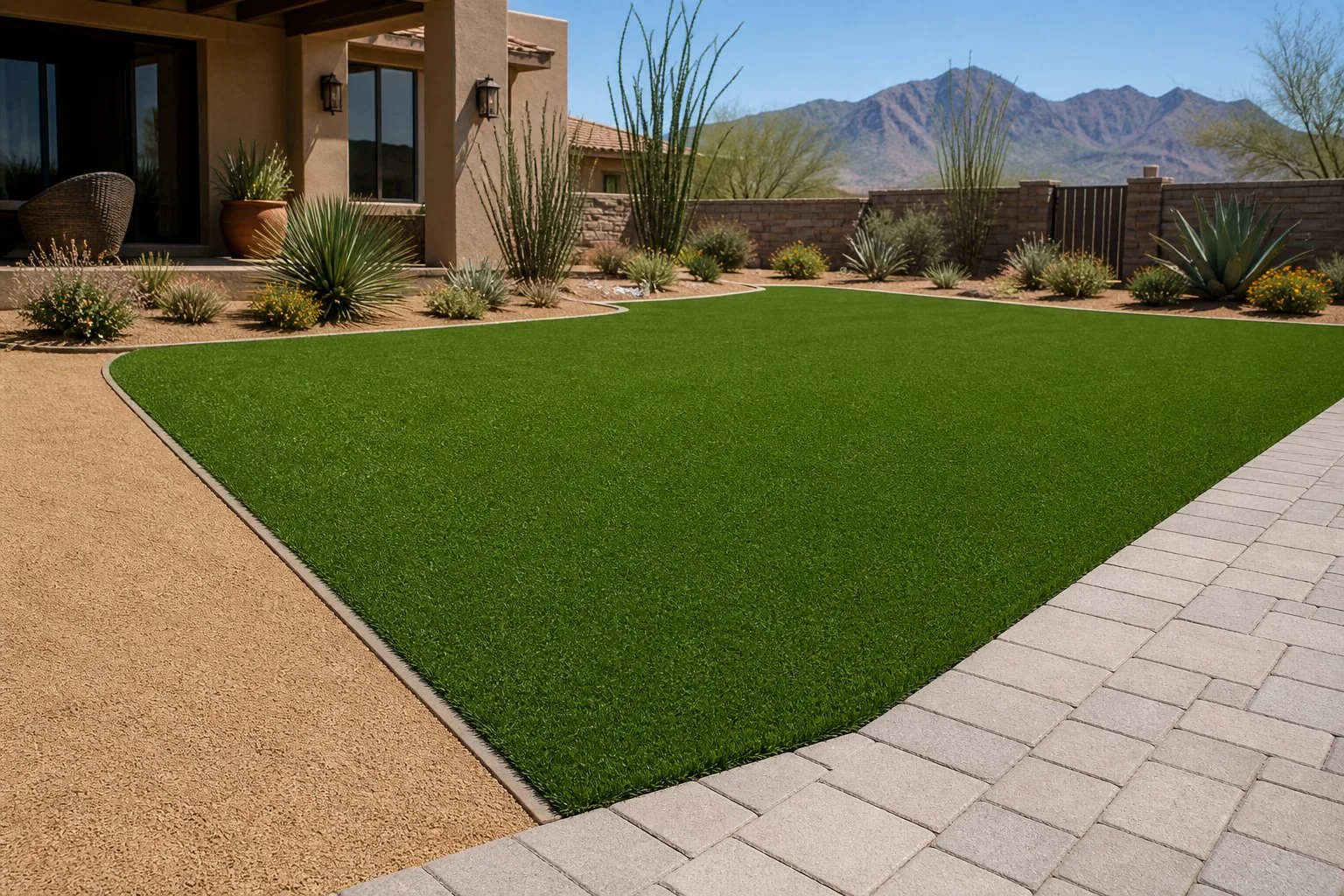
Artificial turf gives El Paso homeowners a green, usable lawn with no mowing and no irrigation. In a Chihuahuan Desert climate where residential watering is limited to designated days and restricted hours, synthetic turf is a practical way to keep a play area, pet run, or front lawn green year-round without spending water on it.
Define the boundary for helpful landscape guide in Artificial-Turf Planning
Natural turf in the desert is expensive in the one resource that is hardest to spend here. It needs its heaviest watering in exactly the months when EPWater restricts watering to before 10 a.m. and after 6 p.m., and it still browns between cycles when the heat runs ahead of the schedule. For a small, heavily used area — the strip children actually play on, the run the dog actually uses — that is a lot of water for a surface that spends August looking tired.
Artificial turf removes that trade-off for the specific areas where a green surface genuinely earns its place. It needs no irrigation at all, so it sits outside the watering schedule entirely, and it looks the same in August as it does in March.
Define the boundary for helpful landscape guide in Artificial-Turf Planning
Almost every artificial turf failure traces back to the base, not the turf. The visible product is the last and easiest part of the job.
Excavation. Existing grass, roots, and soil are removed to a depth that leaves room for a proper base. Laying turf over existing soil is the classic shortcut and it produces exactly the results you would expect: settling, dips, and drainage that fails the first time it rains hard.
Base construction. Crushed aggregate is placed in layers, graded, and compacted. The base is what carries the load, holds the surface flat under years of traffic, and lets water pass straight through rather than pooling.
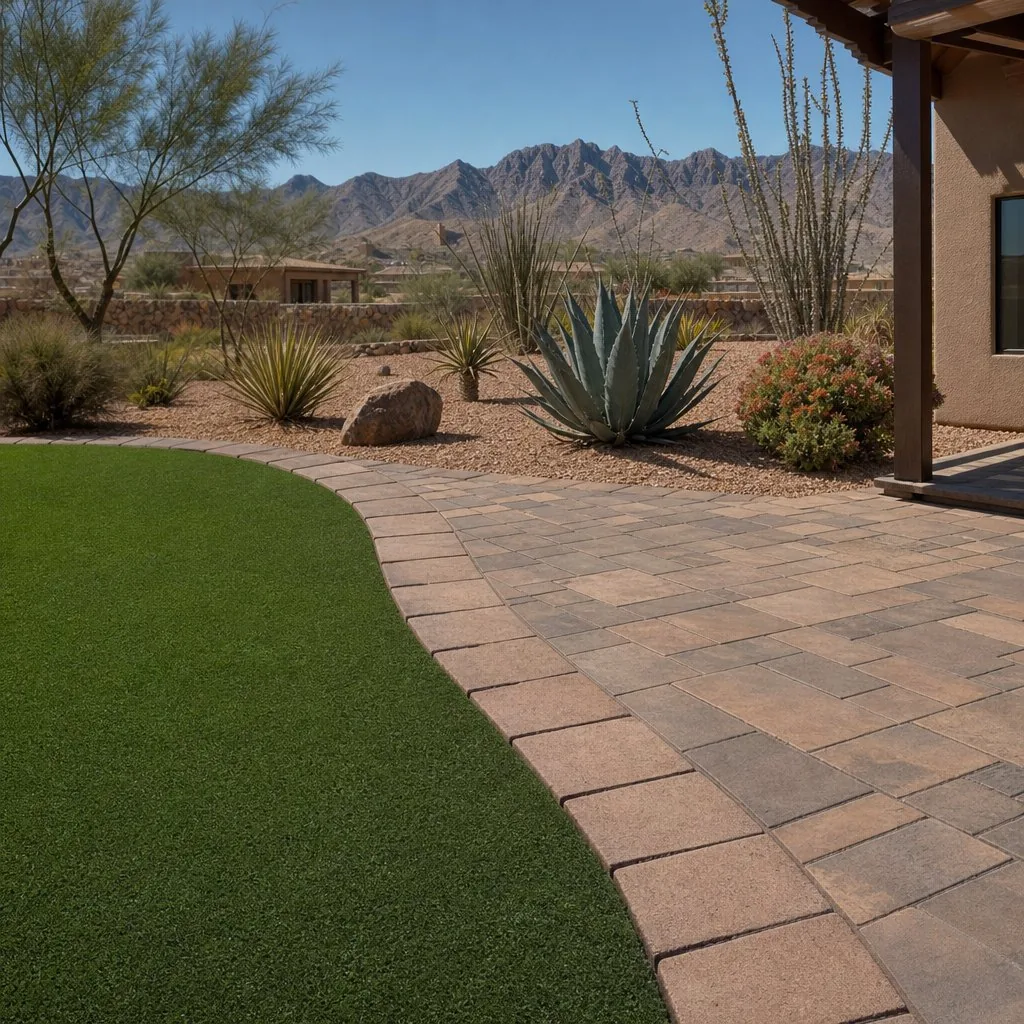
Drainage. Because desert rain arrives in short heavy bursts, the base is graded to move water deliberately. On sites where water has nowhere to go, additional drainage is built in rather than hoped for.
Weed barrier. A permeable barrier over the finished base stops growth from below while still letting water through.
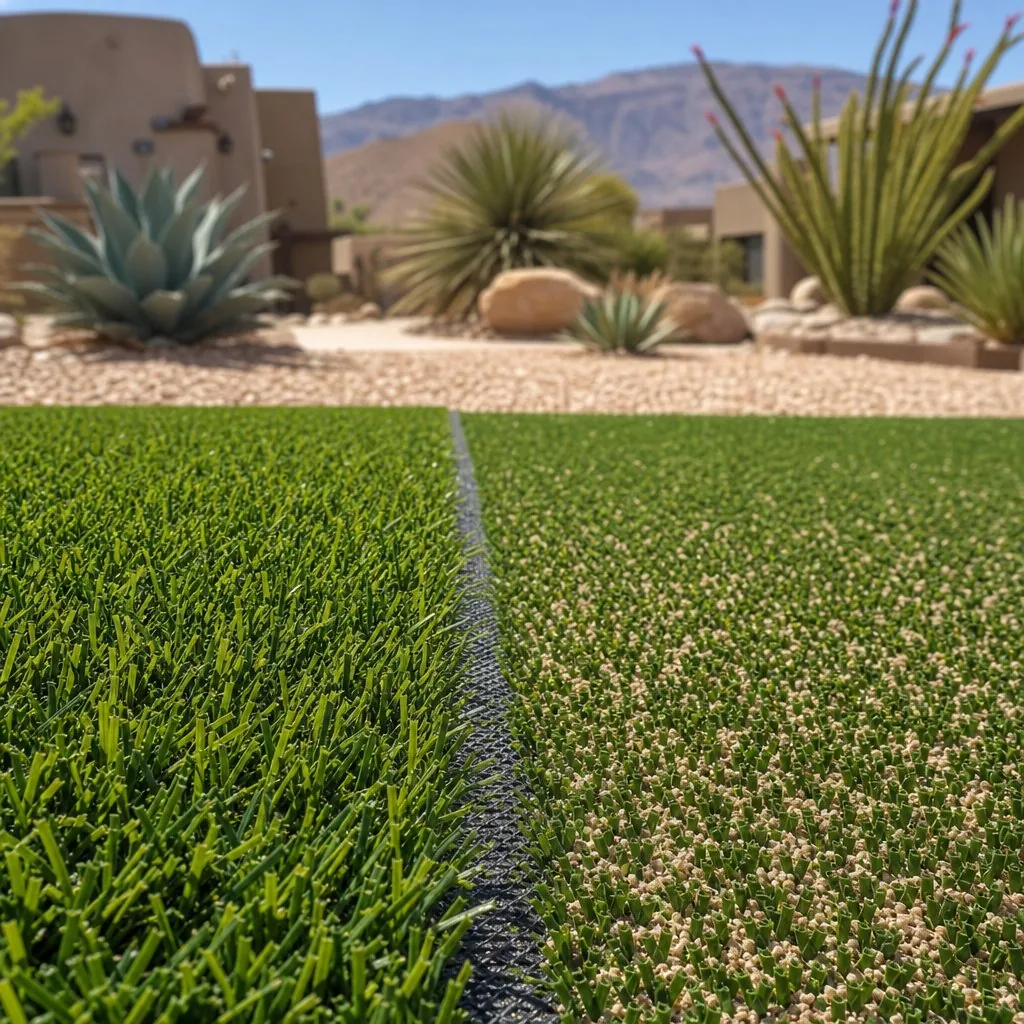
Turf, seaming, and anchoring. Turf is rolled with the pile running in a consistent direction, seamed, and secured at the edges. Consistent pile direction is what makes an install read as a lawn rather than as panels.
Infill. Infill is brushed into the pile to weight the turf, keep the blades standing upright, and protect the backing. It is what determines how the surface feels underfoot and how well it recovers from traffic.
Choosing a product
Turf is not one commodity. Pile height, blade shape, face weight, and backing all vary, and the right specification depends entirely on use. A low, dense pile with high face weight handles heavy foot traffic and recovers well, which suits play areas and pet runs. A longer, softer pile looks more like an unmown natural lawn and suits ornamental front-yard areas that are looked at more than walked on. Pet applications additionally want backing with genuinely free drainage and an infill chosen for odour control. Buying a product designed for one use and installing it for another is the second most common source of disappointment after a bad base.
Define the boundary for Budget Inputs in Artificial-Turf Planning
Cost depends on square footage, how much existing lawn or hardscape must be removed and hauled, how much base preparation and drainage the site needs, the turf product and pile you select, and infill and edging. Site access affects it as well, since base aggregate is heavy and every cubic yard has to reach the work area somehow. Small, awkward, heavily prepped areas cost more per square foot than large open ones. We measure and quote each installation on site.
Timeline
Most residential installations are completed in a few days: removal and grading first, then base placement and compaction, then turf, seaming, infill, and edging. The base work takes the largest share of the time, and compacting it properly cannot be rushed — time saved there is paid back with interest in settling later.
Define the boundary for helpful landscape guide in Artificial-Turf Planning
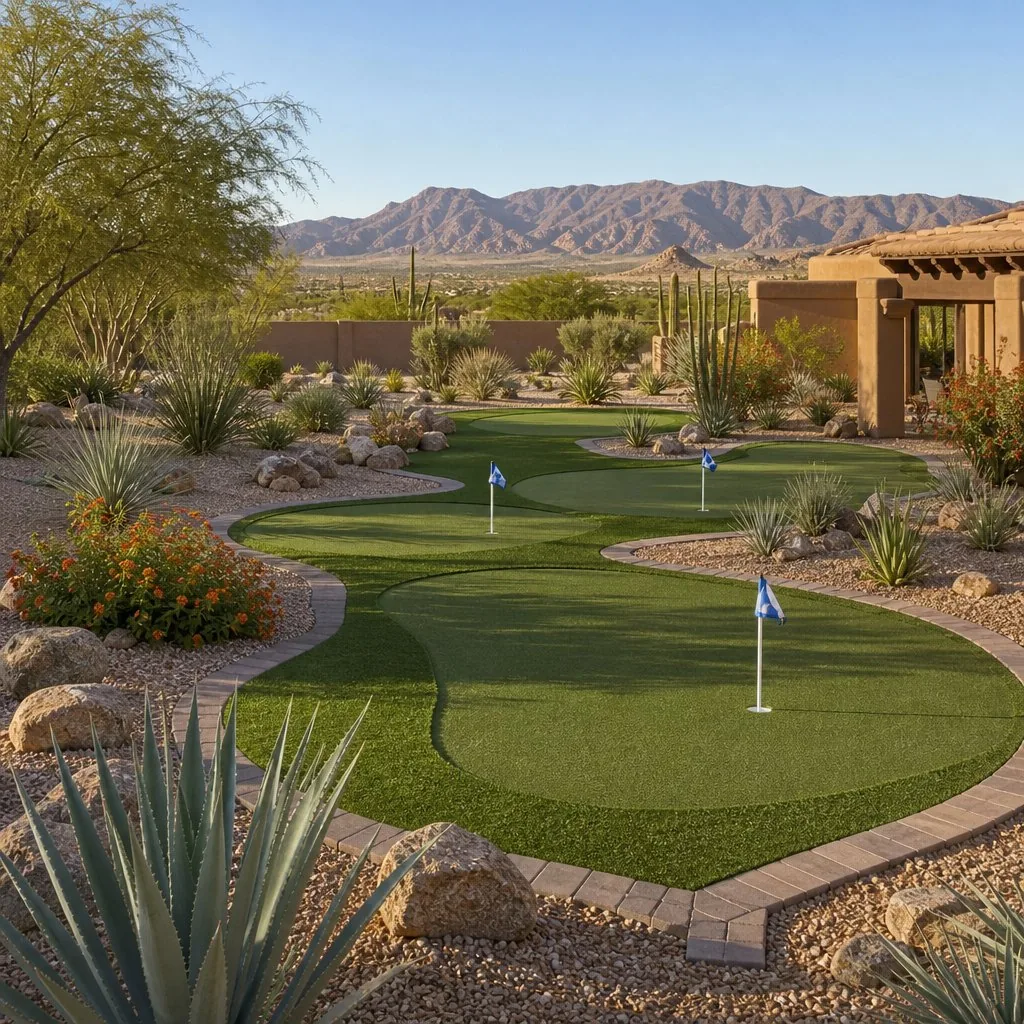
Artificial turf is the right choice where you want a consistently green, genuinely usable surface with no irrigation: play areas, pet runs, small front lawns, courtyards, and shaded side yards where nothing natural will grow well anyway. It is a poor choice as a wall-to-wall replacement for an entire large property, where the cost climbs quickly and the result can look uniform in a way that reads as artificial. The strongest outcome on most El Paso lots is a defined turf area for actual use, with desert landscaping handling everything else.
Local relevance: watering rules make no-irrigation surfaces attractive
El Paso Water (EPWater) limits residential irrigation to up to three days a week on days designated by address — even-numbered addresses Tuesday, Thursday or Saturday, odd-numbered Wednesday, Friday or Sunday — with no residential watering on Mondays. From April 1 through September 30, watering is permitted only before 10 a.m. or after 6 p.m. Water flowing into the street is prohibited, and violations can bring a Class C Municipal Notice of Violation with fines of $50 to $500 per citation. Artificial turf carries no watering obligation at all, so it is unaffected by these limits. (Source: El Paso Water residential watering schedule and Water Conservation Ordinance.)
Define the boundary for helpful landscape guide in Artificial-Turf Planning
Maintenance is light but not zero. Debris and leaves are cleared as they arrive, the pile is brushed periodically in high-traffic lanes to keep blades upright, and infill is topped up over time as it settles and migrates. Pet areas benefit from an occasional rinse. Done routinely, these take minutes; skipped for years, matted pile and depleted infill are what make an older installation start to look its age.
Frequently asked questions
Does artificial turf need watering in El Paso? No. It requires no irrigation and is not subject to EPWater’s watering-day schedule. An occasional rinse for cleaning is all it ever needs.
Does it get hot in the El Paso sun? Synthetic turf warms in direct sun, as any surface does. Product and infill selection, shade, and a quick rinse before use all manage surface temperature; shaded installations stay noticeably cooler than fully exposed ones.
How long does it last? Quality turf is built for many years of service. Realistic lifespan depends on the product specification, how much traffic it carries, and whether the base beneath it was built correctly in the first place.
Is it suitable for dogs? Yes, with the right specification — free-draining backing and an appropriate infill. Pet installations are a distinct build, not the same job with a different label.
What happens to rainwater? It passes through the permeable backing into the compacted base and drains away. This is precisely why base construction and grading matter so much.
Can it go over an existing concrete patio? Often yes, provided the slab drains and the surface is sound. The build-up differs from a soil installation, so it is assessed on site.
Sources
El Paso Water — Residential watering schedule and Water Conservation Ordinance: epwater.org/residential/conservation/watering-schedule.
Review an artificial-turf scope around the El Paso address schedule
Get a Free Quote
Tell us which El Paso yard condition or outdoor use needs attention.
Describe the El Paso Desert Site
Provide the sun exposure, irrigation layout, access, and target use so the Chihuahuan Desert project can be defined before pricing.
Get a Free QuoteFrequently Asked Questions
What should an El Paso artificial-turf planning walkthrough trace before materials are chosen?
Trace where water enters, where it runs and where it collects; then note reflected heat, shade, irrigation reach and equipment access. Those observations define the working limits for artificial-turf planning without pretending an unseen area has already been diagnosed.
How are heat and runoff handled in El Paso artificial-turf planning planning?
Heat exposure and runoff are recorded by zone, not averaged across the yard. The plan can then place preparation, materials and irrigation decisions beside the condition they answer, leaving unrelated areas outside the scope.
What remains undecided until an El Paso property is inspected?
Subsurface condition, usable irrigation pressure, drainage direction and access constraints should stay unresolved until they are checked on site. A responsible artificial-turf planning proposal labels those unknowns and explains how each could affect the work.