
El Paso Lawn and Landscape does leaf removal and full yard cleanups in El Paso and the valley: raking and blowing leaves out of turf and rock, cutting back overgrowth, clearing weeds and hauling every bag, branch and pile away. Every job is priced after we see the yard. Call (915) 465-9148 or request a free quote and we will book the walkthrough.
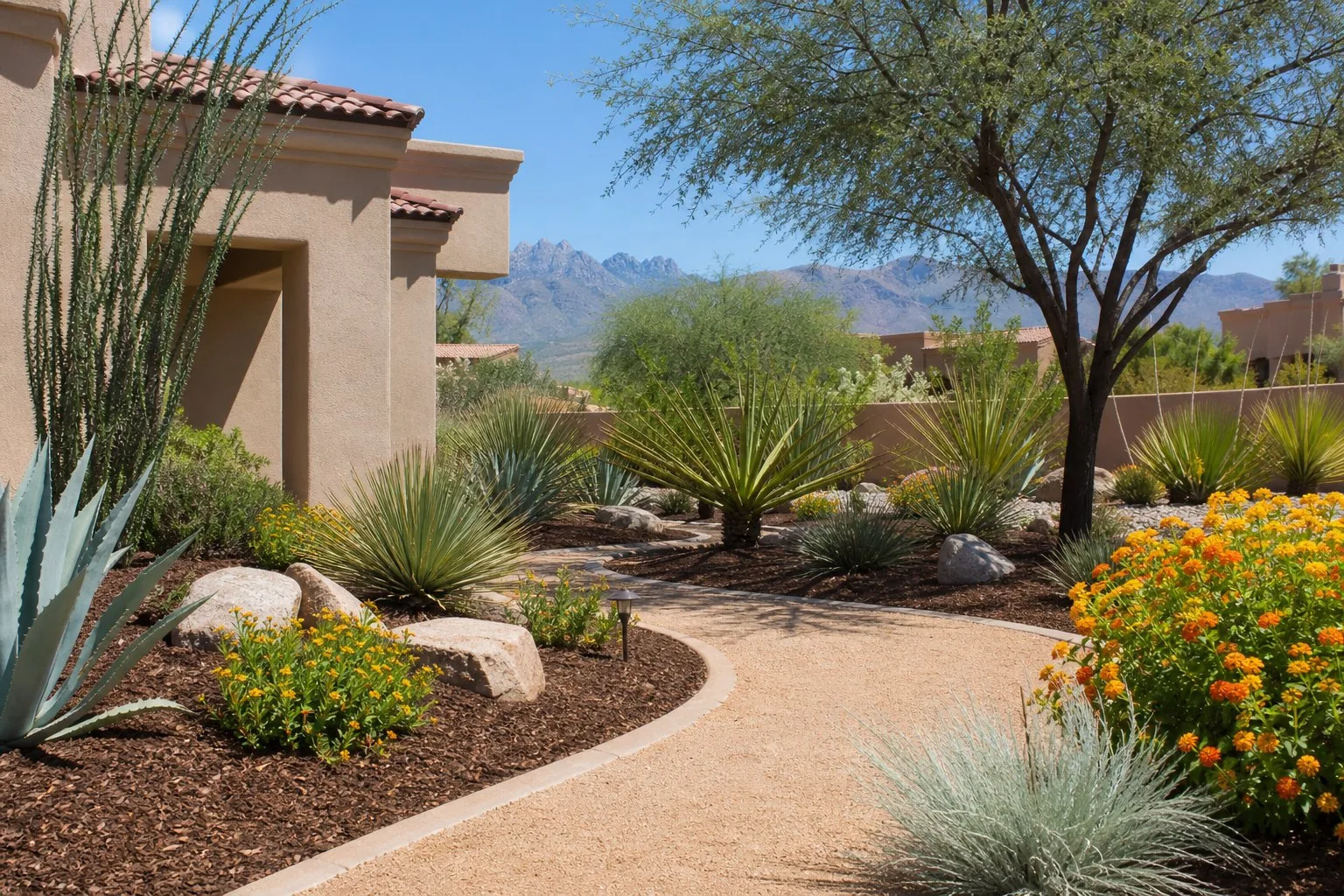
Cleanup in a desert city is a little different from the leaf-bag routine you see in other places. Rock beds trap leaves in ways turf does not, the city will fine you for a weed lot or a hose-down driveway, and the municipal bulky pickup has real limits. This page lays out what we do, what is yours to decide, and what the rules say.
Who does leaf removal and yard cleanup in El Paso?
We do, for homes, rental properties and small commercial lots across El Paso and El Paso County. A crew rakes or blows leaves from turf, rock and planters, cuts back dead growth, pulls weeds, bags debris and hauls it off. You approve a written scope first, so there are no surprises on the day.
Some people call it leaf removal, some call it a spring cleanup, a fall cleanup or a yard reset. The work is the same family: take a yard that has gotten away from you and put it back to a clean baseline that is easy to keep up. Sometimes that is a single visit. Sometimes it is a first big cleanup followed by a lighter recurring visit, and our commercial landscaping scopes work the same way for business properties.
What is included in a yard cleanup?
A standard cleanup covers leaf and debris removal from turf, beds and rock, cutting back dead or overgrown plants, weed removal by hand or string trimmer, clearing walks, edges and corners, bagging and hauling everything away, and a final blow-down so the yard is left tidy. Extras like tree work or bed rebuilds are quoted separately.
To make that concrete, here is what each visit usually breaks into:

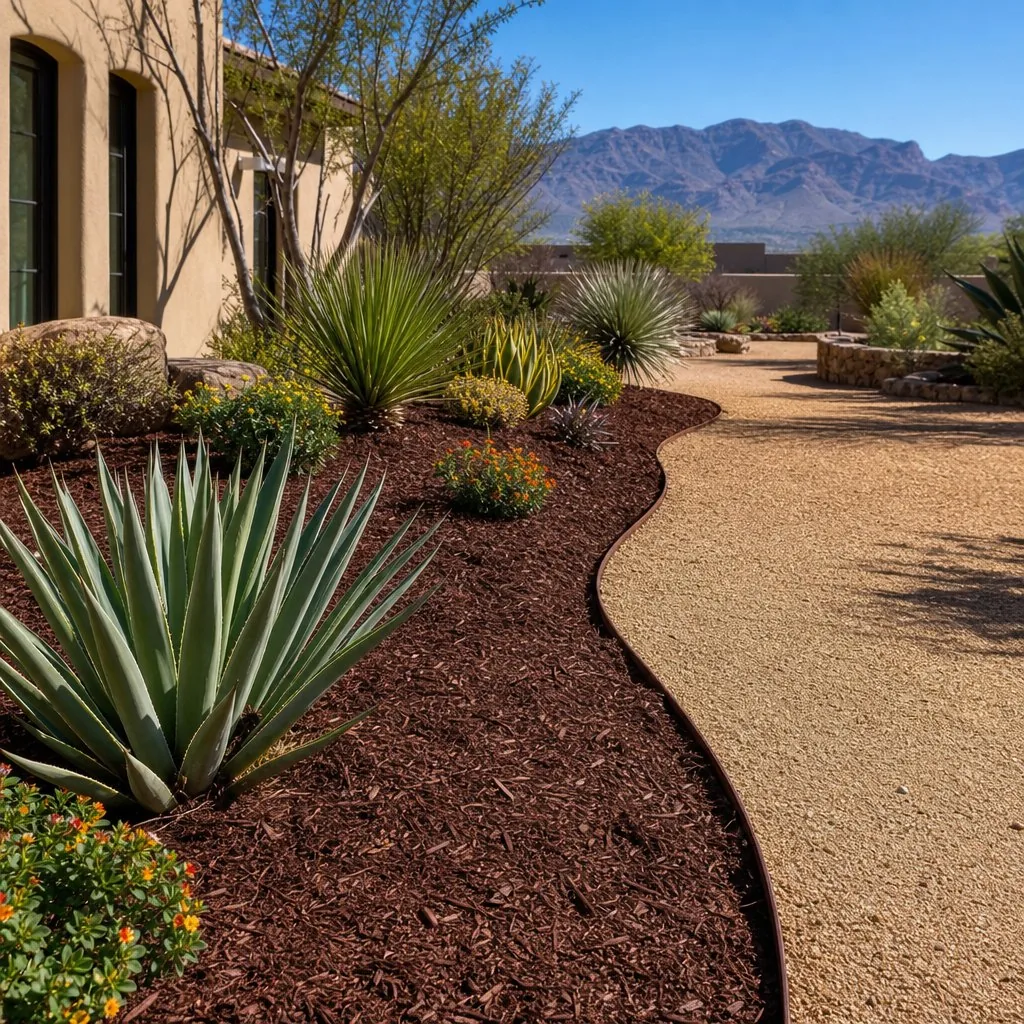

- Leaves and litter: raked or blown from turf, beds, rock and the narrow strips along walls and fences, where wind piles them up first.
- Dead growth: spent perennials, dried grasses, broken branches and shrubs that have died back, cut and bagged.
- Weeds: pulled from beds and rock, and knocked down along fences and property edges.
- Edges: where turf meets walk or curb, and where plants have crept onto paving.
- Haul-off: bagged and bulk material loaded and taken away, including branches under hand-saw size.
- Finish: walks, patios and driveways swept or blown, not hosed.
That last line is deliberate. El Paso’s Water Conservation Ordinance lists washing down impervious surfaces as a prohibited use of water, with exceptions only for hazardous spills or dangerous conditions. Fines run from $50 to $500 per citation. A broom and a blower do the job without the risk, so that is what we use.
When should I schedule leaf removal in El Paso?
Book it when the trees on your property have mostly dropped their leaves, and plan on a lighter second visit if a windy week follows. The timing depends on the trees, not a calendar date. Spring and summer cleanups follow a different logic: they are driven by weed growth and the monsoon, not by leaves.
Leaves in this region do not come down on a single weekend. Different trees let go at different times, and wind in a desert city blows leaves from a neighbor’s yard into yours. A cleanup done too early gets undone by the next gust, and one done too late lets leaves mat down in rock beds where they are harder to get out. We usually suggest watching your own trees and calling us when the bulk is down, then checking back after the last of it drops.
The other cleanup season is the one most people forget. An El Paso television news report in July 2022 quoted a city official saying monsoon season increases vegetation and the chance of fines for overgrown weeds. That is the time of year weeds and grass can take over a side yard in a couple of weeks. If you own a vacant lot or a rental, plan a mid-summer pass as well. Our El Paso landscaping calendar lays out the rest of the year.
How much does leaf removal or yard cleanup cost in El Paso?
We price by the job, not by a published rate, because the amount of material and the access change the labor more than lot size does. A walkthrough gives you a written number for the scope you approve. The city’s own disposal fee, $35 for up to five cubic yards, gives you a sense of the haul-off portion.
What actually moves a cleanup quote:
- Volume of material. A lawn with a few leaves is a different job than a yard under three mature trees with years of buildup in the beds.
- Rock versus turf. Raking leaves out of decorative rock by hand is slower than blowing them off grass, and rock has to be left in place.
- Overgrowth. Weeds taller than a foot need cutting down before anything can be raked, which adds a pass.
- Access. A back yard reached only through a narrow side gate means carrying every bag and branch out by hand instead of loading near the work.
- Haul distance and disposal. The material has to go somewhere, and where it goes affects the trip count.
- Frequency. A one-time reset costs more per visit than a yard that gets a light pass every few weeks.
If you are comparing against a quote from a neighbor or an app, check that it names the haul-off. A low number that leaves the bags at the curb for you to deal with is not the same job.
What does our yard cleanup process look like, step by step?
We walk the yard with you, write down the scope and the exclusions, do the cleanup on an agreed day, haul everything away and send you photos of the finished result. You decide the scope before any work begins, and you can add or drop items at the walkthrough. One crew does it start to finish.
- Request and walkthrough. You send the form or call. We walk the yard, note leaf depth, weed height, rock versus turf, gates and where the debris can be staged. You decide what is in and what is out.
- Written scope and price. The scope lists what will be done, what is excluded and the price. You decide whether to add a lighter follow-up visit or turn it into a recurring schedule.
- Cleanup day (half a day to a full day, depending on size). The crew works top-down: dead growth first, weeds next, leaves and litter last, so nothing gets re-covered. You decide whether you want to be there or not.
- Haul-off (same day). Bagged and bulk material is loaded and taken away. Branches too large for a hand saw are left for the tree work scope.
- Final blow-down and walk-through (same day). Walks, patios and drives are swept or blown, and we check the corners the wind will fill first.
- Follow-up (optional, two to four weeks later). A short visit to pick up what blew in afterward, if you ask for it.
Can I use the city’s bulky pickup instead of hiring a crew?
If you are a City of El Paso resident, often yes. You request a fee-based special pickup at (915) 212-6000, weekdays 7 a.m. to 2 p.m., and it takes brush, tree trunks, branches and green waste. The fee is $35 for up to five cubic yards, plus $7 per extra yard and tax.
The pickup has limits that matter for a cleanup. The city’s list of items it does not take includes dirt, rocks and concrete, so rock from a bed, bagged soil or broken pavers cannot go out that way. It also does not take commercial or industrial generated material, so a business owner or a property with a hired contractor should plan on the contractor hauling. The material has to be at the curb by 6 a.m. on the scheduled day, clear of sidewalks and traffic, and at least five feet from containers, mailboxes, fences, walls, water meters and parked cars.
If you are handy, own a truck and have a couple of days, the city’s route is the cheapest way to get rid of green waste. If you would rather not spend a weekend raking, loading and scheduling a pickup, that is where we come in. Residents can also bring material to the Greater El Paso Landfill or a city Citizen Collection Station, subject to those facilities’ own rules.
What do El Paso’s weed and sidewalk rules mean for my yard?
The city’s code enforcement page says grass, weeds and uncultivated plants must not be allowed to become overgrown, that parkways and alleys are the owner’s responsibility, and that branches must leave at least eight feet of clearance over a sidewalk. A city official has described the vegetation limit as 12 inches.
The 12-inch figure came from a 2022 television news report quoting a city official, who described a warning with 7 to 10 days to fix the problem, a re-inspection and then a clean-up by the city’s environmental services at an average cost of $200. We treat that as the outline, not a promise, and suggest you check the code or call the city if you are under a notice. The takeaway for a cleanup is simple: the strip between your curb and your sidewalk is yours, and so is the alley behind the property.
We include those strips in cleanup scopes by default, and the tree trimming page covers the overhang side of the rule.
How are rock beds cleaned differently from turf?
Leaves and debris in rock beds are lifted out by hand or with a blower on low, not raked, because raking drags rock out of place and into the turf. We top up rock where it has thinned, pull weeds with the root, and leave the bed edge defined so it is easy to keep.
Rock is common in El Paso yards for good reason: it needs no water and no mowing. The cost is that it collects wind-blown leaves, seed pods and dust, and weeds root in the dust that settles between the stones. Caliche and shallow rock under the soil mean beds are often shallow, so a cleanup should never dig deeper than it needs to. Where a bed is failing, we say so at the walkthrough. Rebuilding it is a project of its own, and our desert landscaping page explains how those are scoped.
What does a typical cleanup look like?
These three scopes show how a different yard changes the quote. They are typical examples written to illustrate how we build a scope, not records of finished work, and none of them carries a price because the actual numbers come from the walkthrough measurements.
A typical older neighborhood back yard: mature trees along one fence, a turf area, two rock beds and a side gate. The scope is leaf blowing and raking, a cutback of dead growth, hand weeding of the beds, and bagging and hauling. The side gate sets the pace, since every load goes through it.
A typical rental turnover: a front yard that has been left for a season, with weeds past the knee, trash in the beds and an overgrown edge along the sidewalk. The scope starts with cutting everything down, then clearing, then edging, then hauling. The goal is a property that meets the city’s overgrown vegetation rule on the day the tenants move in.
A typical corner or vacant lot: long street frontage, no irrigation, volunteer weeds and blown litter. The scope is a mow-down, litter pickup and haul-off, with a short recurring visit during the growing season so it stays inside the city’s limit.
What should I do before the crew arrives?
Clear the path and tell us what to protect. Move vehicles, hoses, furniture, toys and pet items off the work area, unlock the gate we will use, and point out anything breakable such as sprinkler heads, drip lines, valve boxes and low-voltage lights. Pets inside, and a note about the gate code, makes the day go faster.
A few specifics help. If you have an irrigation controller, tell us whether the system runs on a timer that will turn on while the crew is working, because a head that pops up under a blower or a trimmer is a head that gets broken. Mark or flag any plants you want kept even though they look dead; many desert natives drop leaves or die back to the ground and come back. If there are areas of the yard you do not want touched, say so at the walkthrough and we will write it into the exclusions.
Will a cleanup show me problems with my sprinklers?
Often it does. Clearing leaves and overgrowth exposes broken heads, wet spots and zones that spray the walk. That matters because El Paso Water treats a leak left more than five working days after you discover it as wasting water, and leaked water can be billed at your highest tier, up to $13.24 per CCF.
We do not repair irrigation as part of a standard cleanup, but we note what we see and tell you. If the system sprays onto the street, that is the second item on the city’s list of wasting water, and it is one of the cheapest things to fix. Our watering rules page explains the days, the 10 a.m. and 6 p.m. cutoffs from April through September and what happens after a citation, and the lawn watering cost page walks through the tier arithmetic if you want to see what a leak costs in a real bill.
How do I keep the yard from needing another big cleanup?
Keep three things on a rhythm: a quick pass for leaves and litter when trees are dropping, a weed pass before growth gets past a hand span, and an edge trim along walks and fences. Small, regular visits cost less than a rescue, and they keep you inside the city’s overgrown vegetation rule without thinking about it.
Some habits that make a difference in a rock-and-turf yard here:
- Do not let leaves sit in rock. Leaves that break down in rock turn into the soil that weeds root in. A blower on low every couple of weeks in leaf season prevents that.
- Cut weeds before they seed. A weed pulled small is a pull. A weed that has dropped seed is next year’s cleanup.
- Mow at a steady height. Texas A&M AgriLife lists 1 to 2 inches with a rotary mower as the recommended height for a bermudagrass home lawn, mowed weekly in the growing season.
- Fix the sprayed pavement. A head aimed at a driveway wastes water and puts a stain and a citation on the property.
- Know your strips. The parkway between curb and sidewalk is the owner’s job under the city’s code enforcement page.
What is the difference between a cleanup and a yard renovation?
A cleanup returns the yard to what you already have. A renovation changes what you have: new beds, new turf, new rock or a rebuilt watering layout. We start most renovation conversations with a cleanup, because you cannot design a bed you cannot see, and the first pass shows what the ground and the irrigation are really doing.
If the cleanup shows you that a bed is failing for good reasons, such as shade, drainage or soil that will not hold a plant, we will say so, and note it in the scope. Bigger changes follow a different path, with a site measurement, a soil and subsurface probe and a plan. Our desert landscaping page covers the rock-and-native side of that work, and our pricing guide lists what the city rebates for water-saving upgrades.
Where in El Paso do you do cleanups?
We work across El Paso and the surrounding valley, including West El Paso, East El Paso, Northeast El Paso, the Upper Valley and the Lower Valley, as well as Horizon City, Socorro, San Elizario, Canutillo and Fabens. Our areas page has the full list.
When you request a quote, tell us the neighborhood, the lot type and where the debris can be staged. Older neighborhoods with narrow side gates and mature trees tend to be hand-carry jobs. Newer lots with open access can usually be loaded closer to the work, and the quote reflects that. For the water bill and rebate side of the yard, our pricing guide covers it.
How do I book a cleanup?
Call (915) 465-9148 or use the free quote form with your neighborhood, what the yard looks like and any gate or access limits. We schedule a walkthrough, send a written scope, and book the cleanup day once you approve it.
Photos speed things up. A wide shot of the yard, a close shot of the worst bed and a picture of the gate you would use for the haul-off are enough. If you have a notice from the city, send that as well, so we can build the scope around its date and make sure the work covers what the notice names.
Get a Free Quote
Tell us which El Paso yard condition or outdoor use needs attention.
Describe the El Paso Desert Site
Provide the sun exposure, irrigation layout, access, and target use so the Chihuahuan Desert project can be defined before pricing.
Get a Free QuoteFrequently Asked Questions
What does an El Paso yard cleanup include?
A cleanup covers removal of leaves, weeds and debris, cutting back overgrowth, and haul-off of green waste. Scope is set per property at the site assessment and named in writing, including what is excluded, so the boundary is explicit. In Chihuahuan Desert conditions gravel and bed areas are tidied alongside planted areas rather than treated separately.
How often should a yard be cleaned up in El Paso?
Most properties are handled seasonally, with the shoulder seasons the practical points. Between October and March the time-of-day watering restriction is not in force, which makes that window easier for work involving running or testing irrigation alongside the cleanup. Frequency beyond that is set by the planting present and by how the property is used.
Is the debris hauled away?
Yes. Debris and green waste removal is included where the written estimate says so, and disposal follows local requirements. Because scope varies by property, the haul-off boundary, meaning what is taken and what is left in place, is stated in the estimate rather than assumed.