Desert Landscaping in El Paso, TX
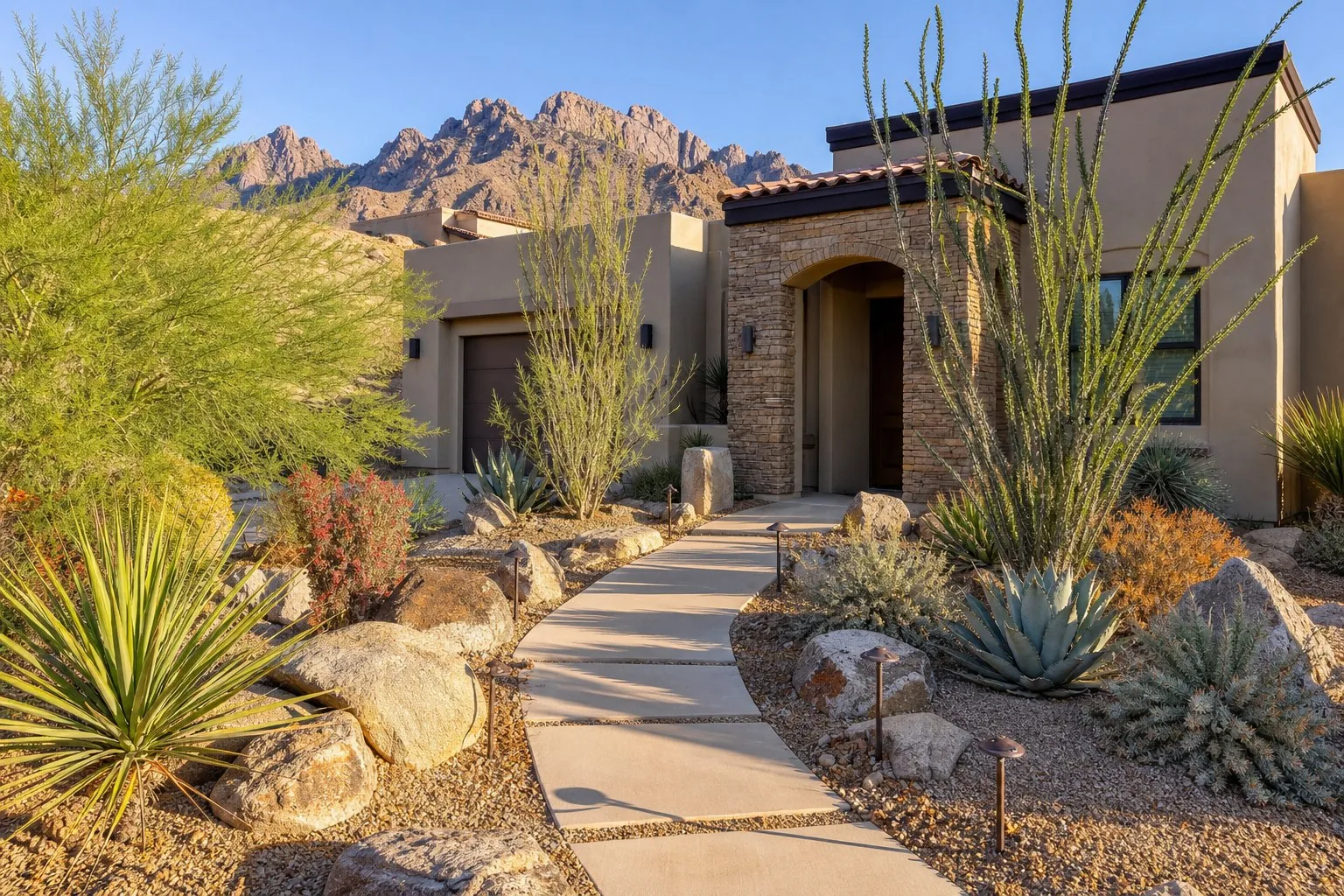
Desert landscaping — xeriscape — replaces thirsty turf with drought-adapted plants, permeable ground cover, and efficient irrigation suited to El Paso’s Chihuahuan Desert climate. For most El Paso yards it is the most durable, lowest-water way to keep a property attractive through a long, hot, dry summer, and it is designed from the start to live comfortably inside El Paso Water’s year-round watering schedule rather than fight it.
Define the boundary for helpful landscape guide in Neighborhood Property Planning
El Paso sits in the Chihuahuan Desert, where summers are hot, rainfall is limited and concentrated into a short late-summer window, and evaporation runs well ahead of precipitation for most of the year. A conventional lawn in that setting is a permanent liability: it needs its heaviest watering exactly when the city restricts watering hours, it browns between cycles, and it consumes water and mowing time without ever really thriving.
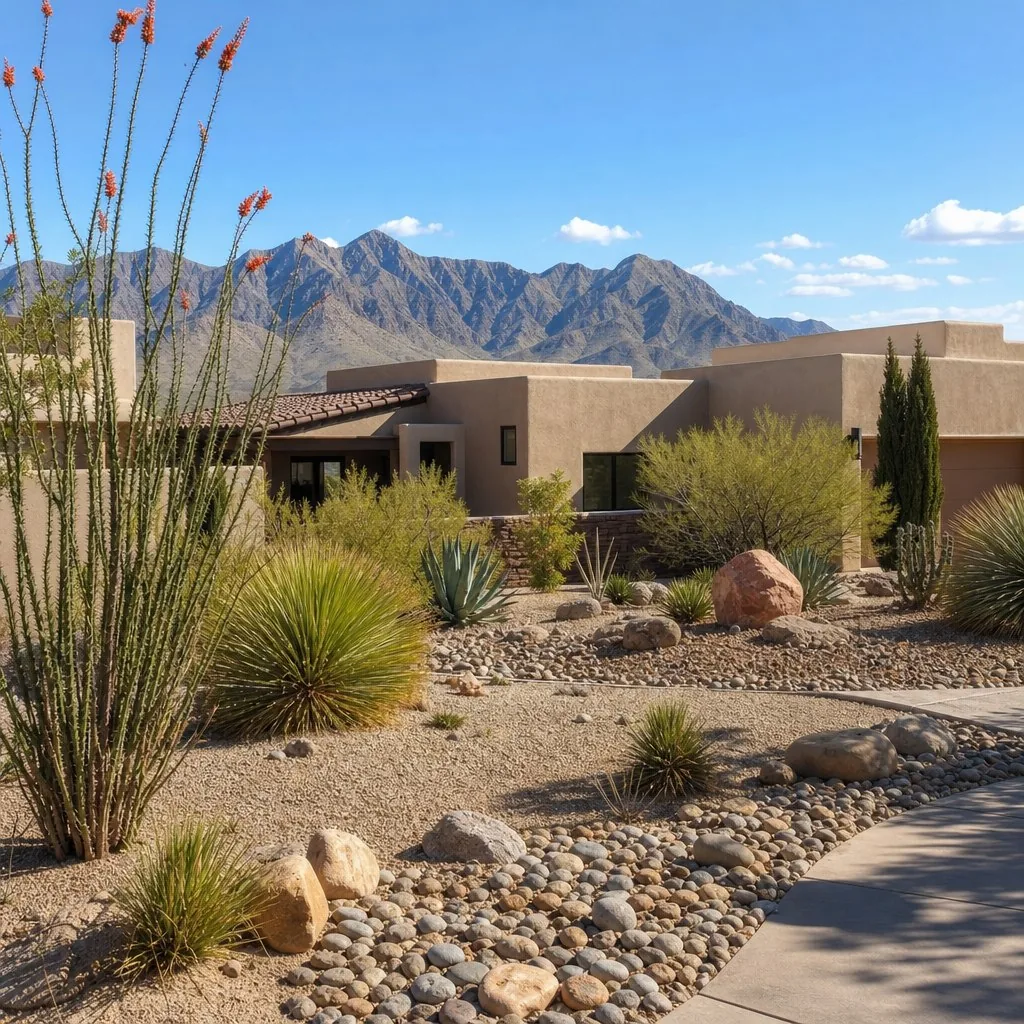
A desert landscape inverts that arithmetic. Plants adapted to arid conditions are chosen because they are already built for the heat load and the dry air. Gravel, decomposed granite, and other permeable ground covers hold soil in place, moderate soil temperature, and let infrequent hard rains soak in instead of sheeting off. Drip irrigation puts water at the root zone on a schedule you control. The result is a yard that still looks intentional in July.
What a desert landscape actually includes
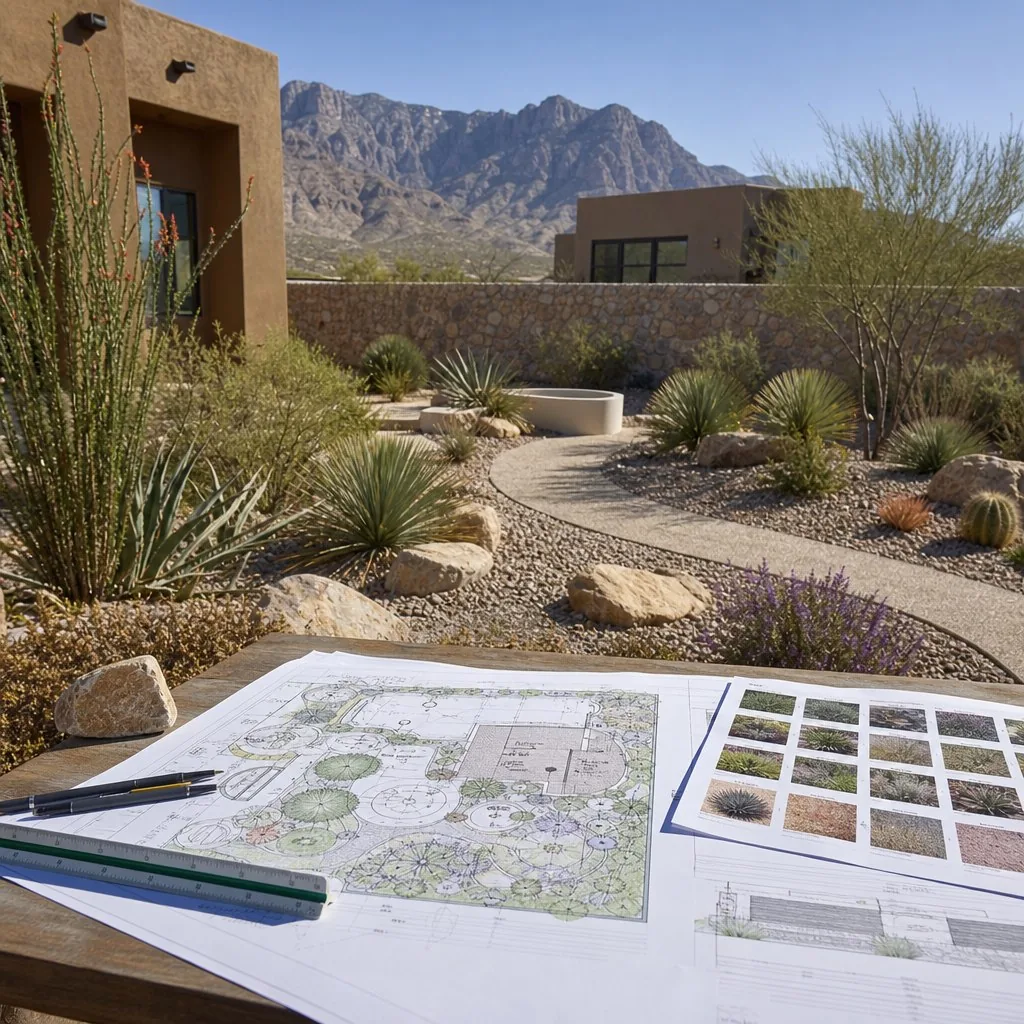
A proper conversion is considerably more than pulling grass and spreading rock. Done well it runs through several distinct stages, and skipping any of them is where disappointing xeriscapes come from.
Removal and site prep. Existing turf, roots, and any failing hardscape come out and are hauled away. Leaving root mass in place is the most common shortcut and the most common source of weeds later.
Grading and drainage. The step most often underdone. Desert rain arrives fast and hard. Shallow swales, basins around trees, and correct fall away from the foundation turn a downpour from a problem into free irrigation.
Edging and separation. Steel, stone, or concrete edging keeps gravel and planting areas from migrating into one another. Good edging is the difference between a landscape that still reads as designed in year five and one that looks like it dissolved.
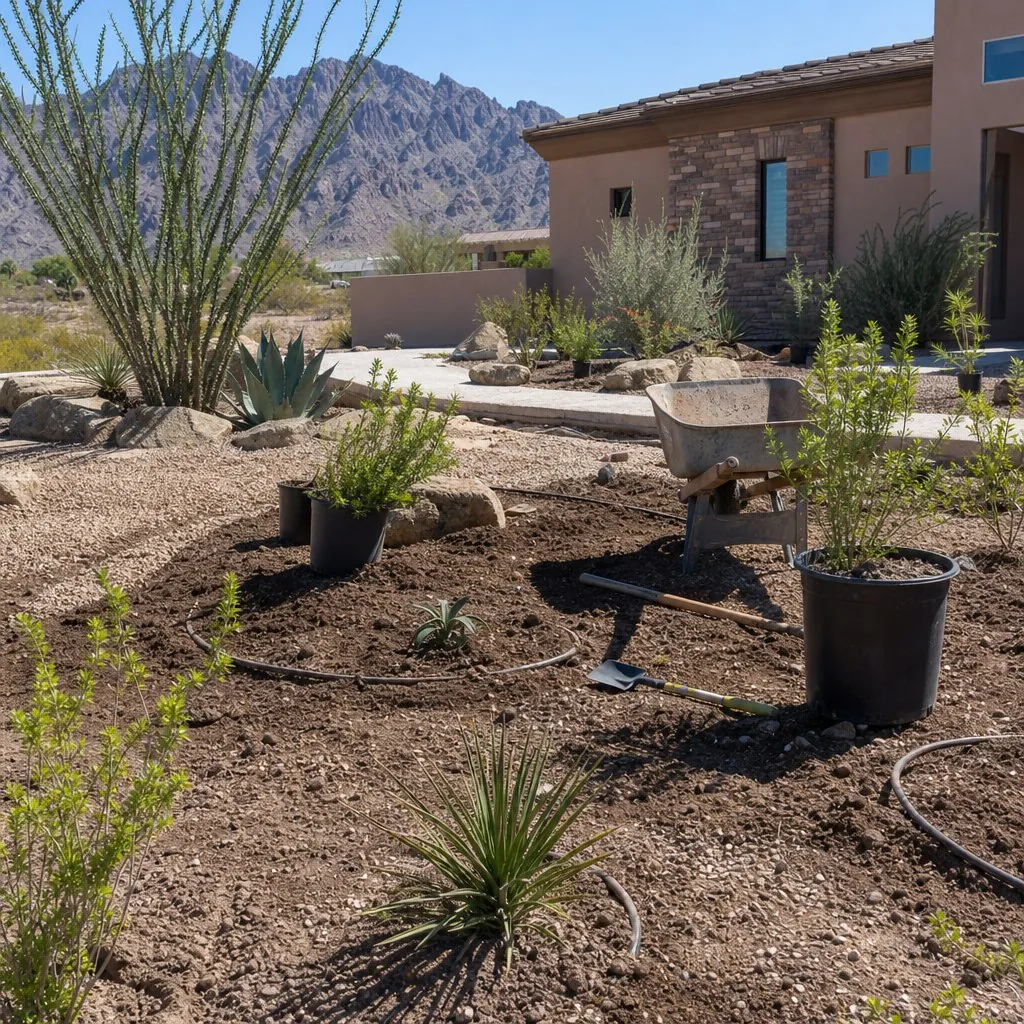
Irrigation. Drip lines and emitters are laid out by plant water need rather than by convenience, and zoned so that establishing plants and mature plants are not forced onto one shared schedule.
Ground cover and planting. Rock or decomposed granite goes down at a depth that genuinely suppresses weeds rather than merely hiding the soil. Plants are set with room for their mature size, not their nursery size.
Plant selection and design
Good desert design is layered. Small trees and larger anchor plants give height and shade; mid-height shrubs give structure through the year; accents and low plantings give seasonal colour and texture. Shade matters more than most homeowners expect — a well-placed tree lowers the surface temperature of everything beneath it and measurably reduces the water demand of the plants in its shadow.
The common failure is treating xeriscape as “zeroscape”: a flat field of gravel with three plants in it. That version is hot, glaring, reflects heat back at the house, and looks unfinished from the day it is installed. A properly planted desert landscape uses only slightly more water and looks incomparably better.
Define the boundary for Budget Inputs in Neighborhood Property Planning
Project cost in El Paso depends on the size of the yard, how much existing turf and hardscape must be removed and hauled, the mix of plants and ground cover you choose, whether a drip system is added or an existing system reworked, and how much grading the drainage needs. Access matters too — a back yard reachable only through a narrow side gate takes materially more labour to move material into and debris out of. Larger conversions and custom hardscape raise the total, while a phased plan can spread both the work and the cost across seasons. Because every yard differs on all of those variables at once, we quote each project on site rather than name a figure sight-unseen.
Timeline
A typical residential conversion runs from a few days to a couple of weeks depending on scope. The usual order is demolition and haul-off, then grading, then irrigation, then edging and ground cover, then planting. Planting is deliberately last so nothing new is walked over while heavy material is still being moved. After planting there is an establishment period — generally the first full growing season — during which new plants need more water than they ever will again.
Define the boundary for helpful landscape guide in Neighborhood Property Planning
Desert landscaping is the right call if you want to cut irrigation water, sit comfortably inside El Paso Water’s schedule, reduce mowing to nothing, and keep a yard that holds its appearance through the hottest part of the year. If you need open play space for children or dogs, a partial conversion is usually the better answer: keep a small, efficient, genuinely used turf area and convert everything that exists only to be looked at. That concentrates your water where it delivers actual use.
Local constraint: El Paso Water’s year-round watering schedule
El Paso Water (EPWater) enforces a watering schedule all year, not only in summer. Landscaped areas may be watered up to three days a week on days designated by address: even-numbered addresses water Tuesday, Thursday or Saturday, odd-numbered addresses Wednesday, Friday or Sunday, and no residential watering is allowed on Mondays. From April 1 through September 30, watering is permitted only before 10 a.m. or after 6 p.m. Water flowing into the street is prohibited outright, and watering on the wrong day or at the wrong time is itself defined as wasting water. Violations can bring a Class C Municipal Notice of Violation, with fines ranging from $50 to $500 per citation. A desert landscape is designed to thrive within these limits rather than test them. (Source: El Paso Water residential watering schedule and Water Conservation Ordinance.)
Caring for it afterwards
A desert landscape is low-maintenance, not no-maintenance. Expect to top up gravel or decomposed granite where it thins, pull the occasional windblown weed before it seeds, prune shrubs and accent plants once a year to hold their shape, and check drip emitters at the start of each season for clogs and breaks. An unnoticed broken emitter is the single most common cause of both a dead plant and a surprising water bill.
Frequently asked questions
Does desert landscaping still need watering in El Paso? Yes, but far less, and far less often. New plantings need regular establishment watering through their first season. Once established, desert-adapted species need only occasional deep watering, easily scheduled inside EPWater’s designated days and permitted hours.
What days can I water in El Paso? EPWater assigns days by address — even-numbered addresses on Tuesday, Thursday or Saturday, odd-numbered on Wednesday, Friday or Sunday, and never on Mondays. From April 1 through September 30, watering is allowed only before 10 a.m. or after 6 p.m.
Will a desert yard look bare? Not if it is designed properly. Layered desert-adapted shrubs, accent plants, and ground cover give year-round texture and seasonal colour. Bare-looking results come from under-planting, not from xeriscape itself.
Can I convert part of the yard instead of all of it? Yes, and it is often the smartest option. Converting the purely decorative areas while keeping a small, genuinely used lawn captures most of the water saving with none of the lifestyle trade-off.
Does all that gravel make the yard hotter? A large unshaded expanse of rock does store and radiate heat. Layered planting and well-placed shade trees are what keep a desert landscape comfortable — another reason not to build a plant-free gravel field.
What happens to my existing sprinkler system? In most conversions the spray heads come out and the system is reworked to drip, which delivers water at the root zone and eliminates the overspray and street runoff that draw citations.
Sources
El Paso Water — Residential watering schedule and Water Conservation Ordinance: epwater.org/residential/conservation/watering-schedule.
Plan a desert-landscape conversion around the El Paso address schedule
What are good landscaping ideas for an El Paso yard?
Start with ideas that suit the climate: replace thirsty turf with drought-adapted plants, use decomposed granite or rock as ground cover, add shade trees, shape shallow swales to catch hard late-summer rain, and put the plants on drip. Keep a small lawn only where people actually use it.
For a worksheet-style approach, see the water-wise landscaping guide and the landscape design page.
Which plants work in an El Paso yard?
Bermudagrass is the heat-adapted turf for El Paso, and regional natives such as lechuguilla, smooth sotol, ocotillo, soaptree yucca and Torrey yucca fit where the site supports them. Soil here is fast-draining and alkaline, so test the planting area before choosing amendments or buying plants.
The plant selection guide and the soil and site guide go deeper.
Can El Paso Water rebates help pay for a desert landscape upgrade?
Some pieces, yes. El Paso Water pays up to $1,000 for a rainwater harvesting system, up to $250 per home for laundry-to-landscape, and a one-time $75 for a WaterSense smart irrigation controller. Apply within 60 days of purchase; the purchase must be after June 1, 2024, and the credit lands on your water bill.
Source: El Paso Water rebate programs, read October 13, 2026. Pair them with drip irrigation planning, and see the cost guide.
Where can I see real El Paso desert landscapes for inspiration?
The Desert Blooms El Paso website runs a home garden gallery and public garden tours built around local landscapes, plus plant lists and watering tips. Pairing a few photographs from there with your own yard measurements makes it much easier to describe what you want in a written project plan.
Source: Desert Blooms El Paso. When you have a list, request a quote.
Get a Free Quote
Tell us which El Paso yard condition or outdoor use needs attention.
Describe the El Paso Desert Site
Provide the sun exposure, irrigation layout, access, and target use so the Chihuahuan Desert project can be defined before pricing.
Get a Free QuoteFrequently Asked Questions
What is desert landscaping in El Paso?
Desert landscaping uses drought-adapted planting, gravel or rock groundcover, and low-water bed design suited to Chihuahuan Desert soil and exposure. Plants are grouped by water need so irrigation can be zoned rather than run uniformly across the property. The approach is shaped by El Paso Water rules, which permit landscaped areas to be watered up to three times a week on assigned days. Scope is confirmed in writing after a site assessment.
How much water does a desert landscape save in El Paso?
Savings depend on what is being replaced, the irrigation method and how zones are separated, so a single percentage would be misleading. What is fixed is the rule set: El Paso Water permits watering up to three times a week on assigned days, and its published guidance is that less frequent watering is often better. The meaningful comparison is your own billed volume measured against your Average Winter Consumption baseline. Source: El Paso Water, read 2026-07-30.
Does a desert landscape still need irrigation?
Yes, particularly during establishment. New planting needs water more often than settled planting, which is why installation is easier to schedule between October and March, when the April 1 to September 30 time-of-day restriction is not in force. Once established, drought-adapted planting is designed to run on less. Zoning keeps establishment areas separate from settled ones so neither is watered on the other's schedule.