
El Paso Lawn and Landscape handles commercial grounds work across El Paso and the valley: mowing, edging, bed and rock upkeep, seasonal cleanups and irrigation checks for offices, retail strips and multi-unit properties. Pricing comes from a site walk, not a rate card. Call (915) 465-9148 or request a free quote and we will schedule the walk.
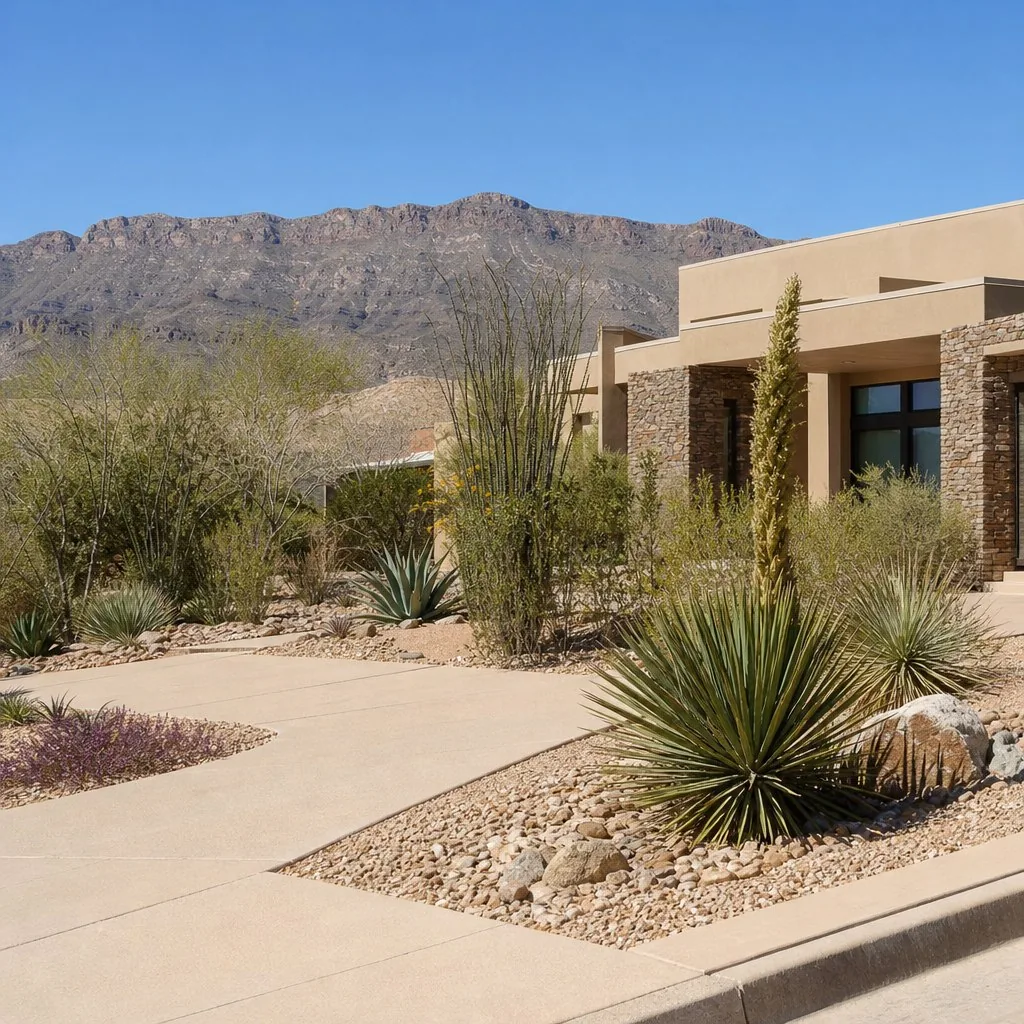
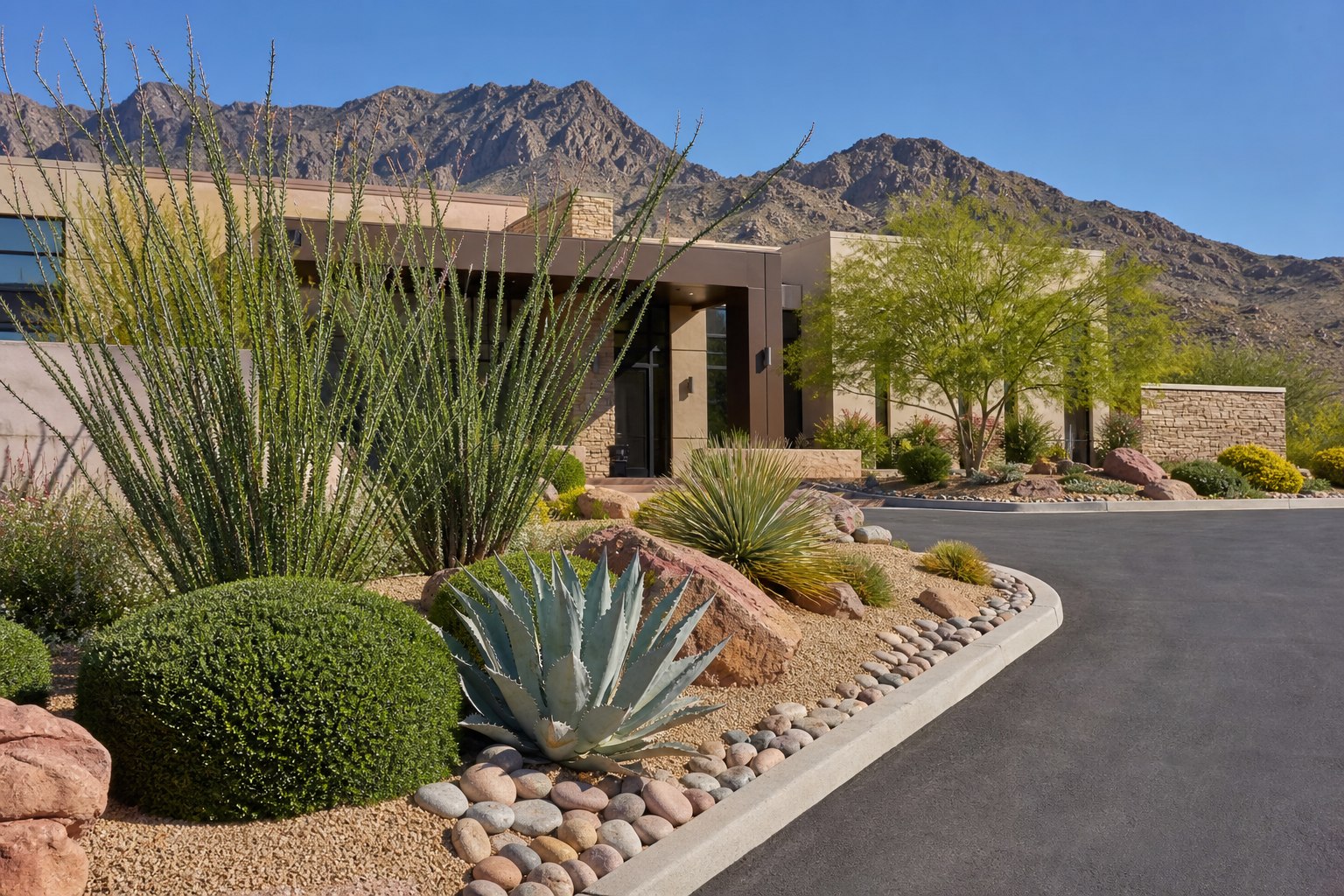
Most commercial properties in this city share three problems: water that is billed at the expensive end of the scale, a watering window that closes at 10 a.m. for half the year, and a city that will fine an owner for a weed lot or a branch over a sidewalk. This page covers how we scope the work around those facts.
Who handles commercial landscaping in El Paso, and what does that cover?
We maintain and improve the outdoor areas of businesses, offices, retail centers, clinics and apartment communities in El Paso and El Paso County. That means recurring grounds maintenance plus one-time upgrades such as turf removal, rock beds, plant replacement and sprinkler zone corrections. You get one point of contact and a written scope.
A commercial property is different from a house in ways that change the scope before anyone picks up a rake. There is usually more frontage, more hard surface for runoff to run across, more public eyes on the curb line, and less tolerance for a crew showing up in the middle of the lunch rush. A manager also needs paperwork that survives staff turnover: what is mowed, what is trimmed, how often, and who gets called when a head breaks.
We split commercial work into two tracks. The first is maintenance, which repeats on a schedule and is priced as a recurring scope. The second is improvement, which is a project with a start and an end: a bed that has to be rebuilt, a strip of failing turf, a side lot that needs to stop looking abandoned. Mixing the two on one invoice is how scopes get argued about later, so we keep them separate on paper.
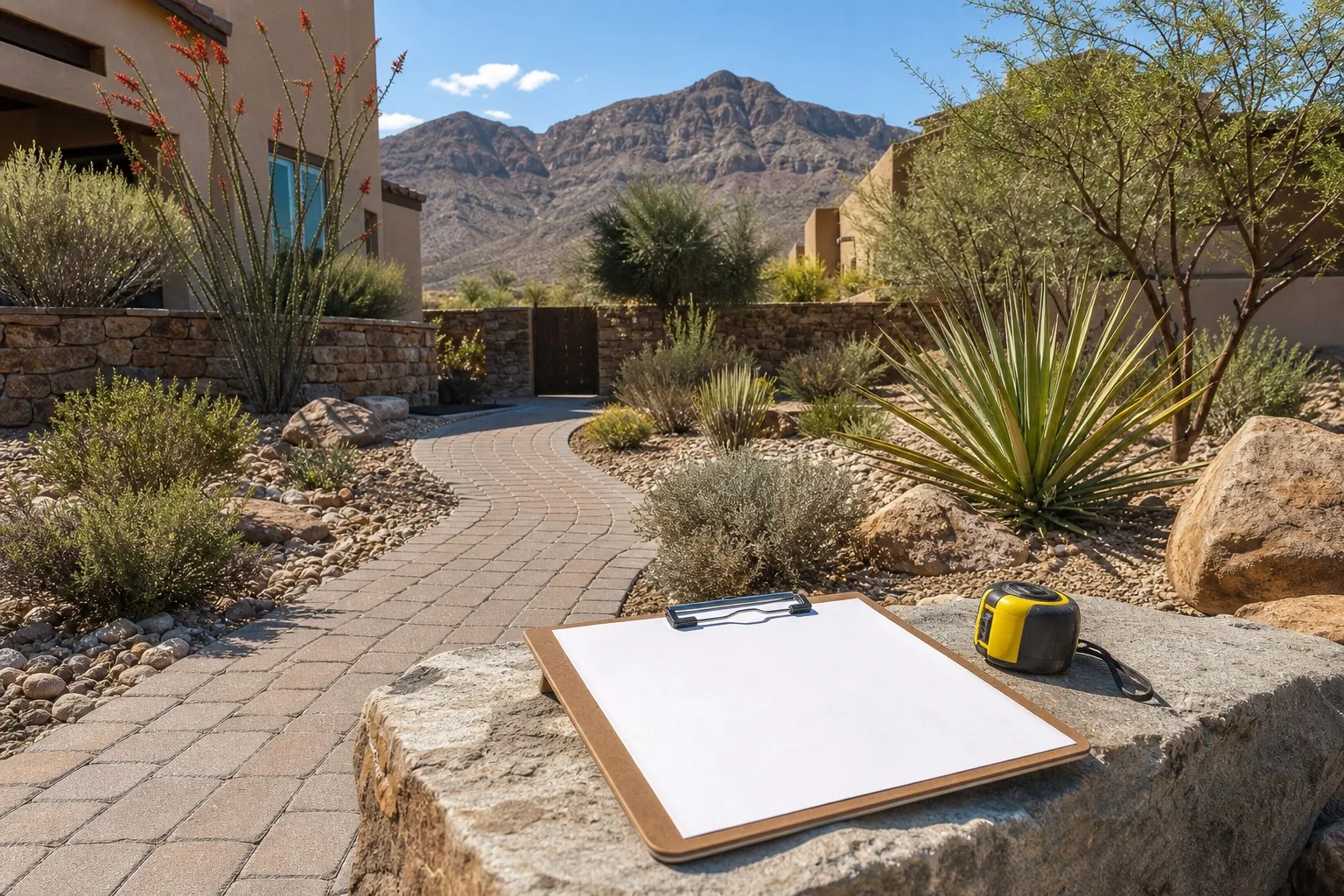
What does commercial grounds maintenance include?
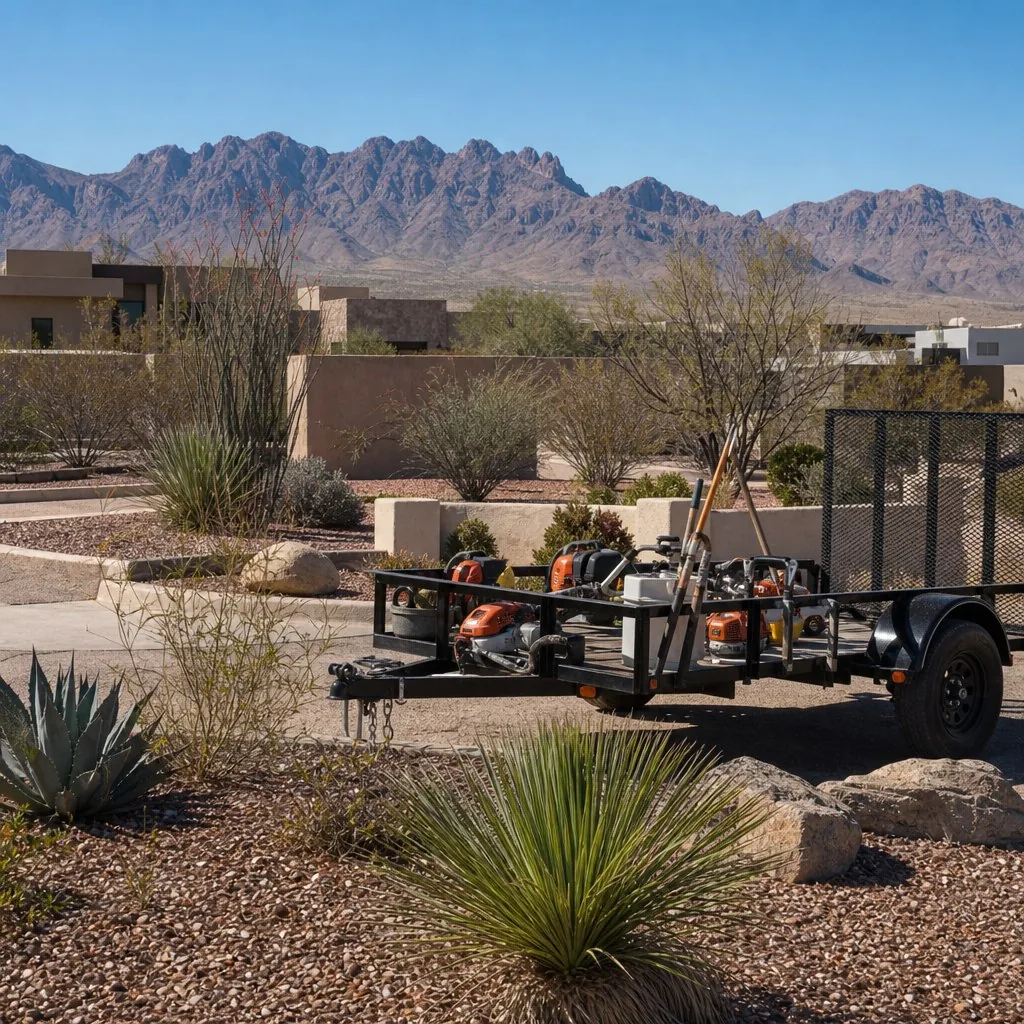
A standard commercial maintenance scope covers mowing and edging turf, trimming shrubs and groundcover, weeding beds and rock areas, clearing debris from walks and parking edges, and a seasonal check of the irrigation. Anything outside that list, such as tree work or replanting, is quoted as its own line so it never hides inside a monthly number.
Here is how the usual line items break out for a commercial site:
- Turf: mowing at a set height, string trimming along walls and fixtures, and edging where turf meets walk or curb.
- Beds and rock: hand weeding, top-up of rock where it has thinned, and keeping plants off walls and glass.
- Shrubs and small trees: shaping and clearing, with larger tree pruning scoped separately, which our tree trimming page explains.
- Debris: blowing and hauling clippings, leaves and windblown litter from the grounds, not just the lawn.
- Irrigation: running every zone, noting broken heads, overspray onto pavement and zones that cannot finish in the permitted window.
- Seasonal work: fall cleanup and early spring cutback, which our yard cleanup and leaf removal page covers in more detail.
Mowing deserves one more note. Bermudagrass is the heat-adapted turf for this climate, and Texas A&M AgriLife lists drought tolerance, heat tolerance, deep rooting and salinity tolerance among its strengths. The same source lists a frequent mowing requirement and a moderate to high fertilization requirement as its weaknesses. For a commercial lawn that means the contract has to assume weekly mowing in the growing season, not a visit when someone complains.
How does the El Paso watering ordinance apply to a commercial property?
El Paso Water lets landscaped areas be watered up to three times a week all year, and from April 1 through September 30 only before 10 a.m. or after 6 p.m. The published days name residential addresses, plus schools, parks, cemeteries, golf courses and industrial sites. Offices and retail are not named, so confirm your day with the utility.
That last point is worth taking seriously. El Paso Water’s schedule says residential addresses skip Mondays, even-numbered addresses water Tuesday, Thursday or Saturday, and odd-numbered addresses water Wednesday, Friday or Sunday. Schools, parks, cemeteries, golf courses and industrial sites are allowed Monday, Wednesday or Friday. A strip center or a medical office is neither a house nor on that second list. Before we program a controller, we ask the property manager to get the assigned days confirmed with the Water Conservation Department at (915) 594-5508 and we write the answer into the scope.
The ordinance defines four things as wasting water, and any of them can bring a Class C Municipal Notice of Violation with fines from $50 to $500 per citation:
- Watering on the wrong day or at the wrong time.
- Letting water run into the public right of way or the storm drain.
- Failing to repair a leak within five working days of discovering it.
- Washing down impervious surfaces, except in emergencies involving hazardous spills or dangerous conditions.
On a commercial lot the second one is the usual trouble. Long frontage, curb cuts and planter strips mean a single misaimed head can put water in the gutter every cycle. The third one is the leak clock. It starts when someone discovers the leak, and on a large property discovery is often a manager walking past a wet patch in July. A written walk-the-zones visit at the start of each season shortens that gap.
Can a commercial irrigation system be adjusted if it cannot finish before 10 a.m.?
Yes, there are two routes. The first is to fix the run times so every zone finishes inside the allowed window. The second is a variance: El Paso Water says variances are usually granted to customers with outdated irrigation systems that cannot irrigate within the allotted time, and are discontinued in drought Stages 2 and 3.
We start with the first route because it does not depend on a board. Many commercial controllers are programmed with one long start time and eight or ten zones stacked behind it. Splitting the program into two start times, shortening cycles on shaded or low-demand zones, and fixing the zones that run long because of a pressure problem is often enough. If the system truly cannot do it, we document which zones fail and for how long, so the owner has something concrete to bring to the utility. Applying for the variance is the owner’s step, and El Paso Water puts the burden of showing hardship on the customer.
A note on rates. The El Paso Water tier figures we publish on our lawn watering cost page are for residential service: $3.92 per CCF up to 150 percent of a customer’s average winter consumption, $9.26 from there to 250 percent, and $13.24 above that, with an $11.82 minimum charge on a meter under one inch. Commercial accounts are billed on their own schedule, so use your own bill to price the water. The shape of the lesson still carries over, because a landscape that leaks or oversprays is paying for that water, and a lot of turf is the most expensive thing on a property to keep green.
How much does commercial landscaping cost in El Paso?
There is no honest citywide number, so we do not print one. Commercial landscaping is priced on turf area, bed and rock area, visit frequency, haul-off volume and what the irrigation needs. We walk the site, measure it, and give you a written scope with each line priced so you can compare it to another bid on equal terms.
What moves a commercial quote most, in rough order:
- Turf area and mowing frequency. Weekly mowing in the growing season is a different annual number than a visit every other week, and turf is the line that also drives the water bill.
- Hand work. Rock beds that have to be weeded by hand, tight planter strips and plants growing against walls cost labor, and that labor does not shrink as the lot gets smaller.
- Haul-off. The city’s special collection program serves residents and does not take commercial or industrial generated material, so debris from a business site has to be hauled by the contractor.
- Irrigation condition. A sound mainline and manifold is a repair job. A system that has to be replaced is a different project, and we say which one it is after every zone has been run and watched.
- Soil and subsurface. Caliche and shallow rock turn planting holes and trenching from hand work into machine work, and the depth is a probe question, not an estimate question.
- Access. Gated courtyards, loading docks and tenants with set hours change when and how a crew can work.
If you are comparing bids, ask each company to price the same measured area on the same visit frequency. A cheaper number that mows every second week is not cheaper than a weekly number.
What does our commercial landscaping process look like, step by step?
We start with a site walk, then a written scope with each line priced, then a first visit that resets the property to a baseline, then the recurring schedule. You decide at the scope stage, and nothing is started before you approve it.
- Request and site walk (day 1 to about one week). You call or send the quote form. We walk the property with whoever manages it, note turf, beds, trees, irrigation, access and tenant hours, and photograph problem areas. You decide who our contact is on site.
- Measure and probe (same visit). We measure turf and bed areas, probe for caliche or rock where planting is in the scope, and run every irrigation zone to see what fails. You decide whether you want an irrigation findings sheet separated from the maintenance quote.
- Written scope and price (a few days later). You get the maintenance lines, the improvement lines and the exclusions in writing, with the watering window and assigned days noted. You decide which lines to approve, and you can approve maintenance without approving any upgrade.
- Baseline visit (one to two days on site, depending on size). A first cleanup resets the property: overgrowth cut back, beds cleared, debris hauled, broken heads tagged. You decide what gets photographed for your records.
- Recurring schedule (weekly or every other week in season). Crews work a set day and set hours that fit tenant traffic. You decide whether the visit window should avoid opening hours.
- Seasonal checkpoints (spring and fall, about half a day each on a small site). We re-run the irrigation zones, adjust controller programs against the watering rules, and flag anything that needs a repair or replacement quote.
What does a typical commercial job look like?
The three scopes below are illustrations of how we build a quote, not records of finished work. They show how a different property type changes the line items, and none of them carries a price because the numbers depend on the measurements from a site walk.
A typical small office on a street frontage: a strip of bermudagrass along the street, two shrub beds flanking the entry, a rock bed along one wall and a handful of small trees. Weekly mowing in season, edging and string trimming, hand weeding of the beds, a spring cutback and a fall cleanup. The irrigation walk usually finds a couple of heads aimed at the sidewalk and one zone that runs long.
A typical retail strip with a shared parking lot: parking-lot islands and planter strips with little turf and a lot of rock and shrubs, plus a front lawn or two near the road. Work is mostly hand work and debris: clearing windblown litter and leaves from the islands, trimming shrubs back from signs and storefront glass, and keeping rock beds edged. Crews work early so they are done before customers arrive.
A typical apartment community: larger turf areas around buildings, a mix of shrubs, trees and common-area beds, and several irrigation controllers. The scope adds tree clearance along walks, a more thorough fall cleanup, and a conversation about whether decorative turf should be replaced with a rock or native bed. That last decision is made from the water bill, not the brochure.
Should a commercial property keep its turf or replace some of it?
Keep turf where people actually walk, sit or play, and replace the decorative strips nobody uses. Bermudagrass tolerates heat and drought but needs weekly mowing and regular feeding, while rock beds and native plants need little water once established. Every square foot removed also removes the water that would have been billed at your top tier.
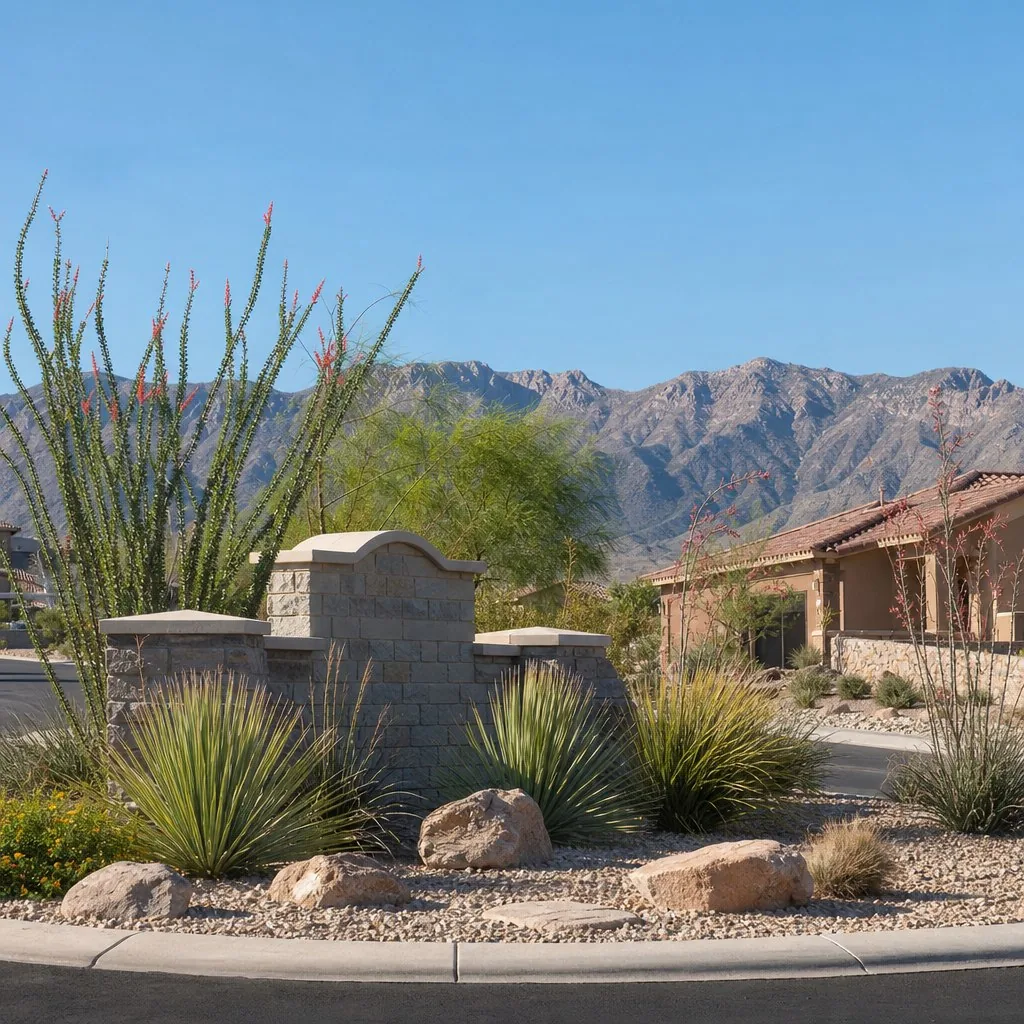
The plants that tend to show up on commercial desert beds here include lechuguilla, smooth sotol, ocotillo, soaptree yucca and Torrey yucca, where the site supports them. USDA zone 8b is the planting zone across the ZIP codes we have sampled, and the soil is fast-draining and alkaline, which is why we test at the property instead of assuming a citywide profile. Our desert landscaping page covers the plant and rock side in more detail.
| Area type | Usually works | Why |
|---|---|---|
| Lawn people walk or sit on | Bermudagrass, mowed weekly in season | Takes foot traffic and heat, but needs mowing and feeding |
| Narrow strips along the curb | Rock with shrubs or native plants on drip | Mowers struggle in narrow strips and sprinklers overspray onto the street |
| Parking-lot islands | Rock with a few hardy plants | Heat off the pavement and little room for roots |
| Entry beds | Mixed shrubs and natives, drip irrigation | Visible every day and worth the care |
What do El Paso’s weed and sidewalk rules mean for a commercial owner?
The city’s code enforcement page says grass, weeds or uncultivated plants must not be allowed to become overgrown, that vegetation in parkways and alleys is the owner’s responsibility, and that branches and shrubs must leave at least eight feet of clearance over a sidewalk. A city official has put the vegetation limit at 12 inches.
The 12-inch figure came from a city official in a 2022 television news report, and the code section cited on the city’s page is 9.04.860. That official described the enforcement path as a warning with 7 to 10 days to correct the problem, a re-inspection, and then a clean-up by the city’s environmental services department at a cost the official gave as $200 on average. We would treat the process as the shape of it, not a schedule you can count on, and check the current code if your property is under notice.
For a commercial owner, the practical points are the edges you do not think of as yours: the parkway strip between the curb and the sidewalk, the alley behind the building, and the vacant side lot. Our maintenance scopes name these areas explicitly so they are never in the gap between what the owner thought was included and what the crew thought was the tenant’s.
Do you spray weeds and pests on commercial grounds?
Spraying is outside the scope this page describes. Texas requires anyone who applies any pesticide, including general-use products, to ornamental plants, trees, lawns or weeds for hire to be licensed by the Texas Department of Agriculture. Applicators who apply only fertilizer are exempt. If a bid includes spraying, ask for the license category.
The Department of Agriculture lists the Landscape Maintenance and Vegetation Management categories under its agricultural pesticide license, and a Lawn and Ornamental or Weed Control category under the Structural Pest Control Service license. The details of which category fits a given property are on the department’s own page. For hand weeding, mulching and rock, no license is involved, which is why those lines sit in the maintenance scope.
Which parts of El Paso do you work in?
We work across El Paso and the surrounding valley. Our service pages cover West El Paso, East El Paso, Northeast El Paso, the Upper Valley and the Lower Valley, plus Horizon City, Socorro, San Elizario, Canutillo and Fabens.
Different parts of the county ask for different things. A commercial strip on the east side tends to be a parking-lot problem. A property in the valley may have more open ground and more turf to maintain. A site out toward Horizon City or Fabens means we plan the visit day around travel. We tell you in the scope which visit days work for your location, and the full list of areas is on our areas we serve page.
What should a commercial landscaping bid spell out?
A good bid names the measured area, the visit frequency, the season it covers, what is excluded, who hauls debris, which irrigation days were assumed and how problems are reported. If any of those are missing you cannot compare two bids honestly, and the missing line is usually where the argument starts later.
Here is the checklist we hold ourselves to:
- Turf and bed areas in square feet, and how they were measured.
- Visit frequency and the days and hours crews will be on site.
- What is included in each visit and what triggers an extra charge.
- Who hauls debris and where it goes.
- The watering days and window assumed for the irrigation, and who confirmed them.
- How broken heads, leaks and dead plants are reported and approved for repair.
- What is explicitly excluded, such as spraying, tree removal or replanting.
For a broader look at how to compare local companies, our guide to choosing a landscaper in El Paso goes through the questions worth asking, and our pricing guide explains the rebates and the cost drivers that apply here.
How do I get a commercial quote?
Call (915) 465-9148 or send the free quote form with the property type, the rough size, what is bothering you and the days that work for a walk. We schedule the site visit first and give you the written scope after it.
Photos help: a wide shot of the frontage, the irrigation controller, any bed that is failing and any area where water runs to the street. If you already have a bid from another company, send it along. We will price the same measured scope so the two compare line by line, and we will tell you where the other bid left something out.
Get a Free Quote
Tell us which El Paso yard condition or outdoor use needs attention.
Describe the El Paso Desert Site
Provide the sun exposure, irrigation layout, access, and target use so the Chihuahuan Desert project can be defined before pricing.
Get a Free QuoteFrequently Asked Questions
What should an El Paso commercial grounds planning walkthrough trace before materials are chosen?
Trace where water enters, where it runs and where it collects; then note reflected heat, shade, irrigation reach and equipment access. Those observations define the working limits for commercial grounds planning without pretending an unseen area has already been diagnosed.
How are heat and runoff handled in El Paso commercial grounds planning planning?
Heat exposure and runoff are recorded by zone, not averaged across the yard. The plan can then place preparation, materials and irrigation decisions beside the condition they answer, leaving unrelated areas outside the scope.
What remains undecided until an El Paso property is inspected?
Subsurface condition, usable irrigation pressure, drainage direction and access constraints should stay unresolved until they are checked on site. A responsible commercial grounds planning proposal labels those unknowns and explains how each could affect the work.