
Last updated: July 30, 2026
Quick answer: El Paso Water prices summer irrigation against your own winter usage. Your Average Winter Consumption (AWC) — the average of your December, January and February billing periods — sets the boundaries of the rate tiers you will be charged at in July. Volume above the 5 CCF allowance costs $3.92 per CCF up to 150% of your AWC, $9.26 from there to 250%, and $13.24 above that: the top tier is 3.38 times the first. Because the boundaries move with your baseline, the counter-intuitive result is real: a household that uses less water in winter pays more to irrigate the same lawn. On the assumptions below, a 5,000 sq ft lawn costs about $184.59 a month to water at an AWC of 6 CCF, but about $150.03 at an AWC of 10 — roughly $35 a month more for being frugal in January.
How El Paso’s water pricing actually works
Most utilities set fixed volume thresholds that apply to everyone. El Paso does not. Here the thresholds are computed per customer, from that customer’s own winter behaviour.
Effective with meter readings taken after March 1, 2026, the residential structure is:
- Minimum monthly charge (meter less than 1"): $11.82, which includes a 5 CCF volume allowance
- Over 5 CCF up to 150% of AWC: $3.92 per CCF
- Over 150% up to 250% of AWC: $9.26 per CCF
- Over 250% of AWC: $13.24 per CCF
Average Winter Consumption is the average amount of water used during the most recent December, January and February billing periods. One CCF is one hundred cubic feet.
The design intent is reasonable: index each household’s summer allowance to its own established baseline rather than to a citywide average. The side effect is what nobody tells you.
The side effect: a low winter bill raises your summer rate
Your AWC does not change what you pay for water in winter. It changes where the expensive tiers begin the following summer.
A household averaging 6 CCF in December–February crosses into the $9.26 tier at 9 CCF and into the $13.24 tier at 15 CCF. A household averaging 10 CCF crosses those same boundaries at 15 CCF and 25 CCF. Identical lawns, identical irrigation, different bills — because the tier boundaries sit in different places.
That is not a loophole to game. Deliberately running water in January to buy a higher summer allowance would waste water in a desert to make watering cheaper, which is precisely the behaviour the ordinance and the rate structure exist to discourage. But it is worth understanding, because it explains a bill that otherwise looks inexplicable — particularly for a household that travelled over the winter, or moved in during spring, or simply lives lightly.
Define the boundary for Water-System Observations in Watering Decisions
The conversion is geometry, not estimation. A cubic foot of water spread one inch deep covers twelve square feet, and one CCF is one hundred cubic feet:
CCF = lawn area in sq ft × depth in inches ÷ 12 ÷ 100
One inch over 1,000 sq ft is 0.8333 CCF. At one inch per week over a 30-day month that is 3.571 CCF per 1,000 sq ft.
What it costs, at two different baselines
Both tables assume one inch of water per week and a 30-day month. The AWC figure is a stated assumption — substitute your own December–February average, which is on your bills.
Household with AWC of 6 CCF (tier 2 begins at 9 CCF, tier 3 at 15 CCF):
| Lawn area | Irrigation CCF/month | Total CCF | Added cost per month |
|---|---|---|---|
| 1,000 sq ft | 3.57 | 9.57 | $17.05 |
| 2,500 sq ft | 8.93 | 14.93 | $66.66 |
| 5,000 sq ft | 17.86 | 23.86 | $184.59 |
| 7,500 sq ft | 26.79 | 32.79 | $302.80 |
| 10,000 sq ft | 35.71 | 41.71 | $421.02 |
Household with AWC of 10 CCF (tier 2 begins at 15 CCF, tier 3 at 25 CCF):
| Lawn area | Irrigation CCF/month | Total CCF | Added cost per month |
|---|---|---|---|
| 1,000 sq ft | 3.57 | 13.57 | $14.00 |
| 2,500 sq ft | 8.93 | 18.93 | $55.98 |
| 5,000 sq ft | 17.86 | 27.86 | $150.03 |
| 7,500 sq ft | 26.79 | 36.79 | $268.24 |
| 10,000 sq ft | 35.71 | 45.71 | $386.46 |
Two things stand out. First, the same 5,000 sq ft lawn differs by about $35 a month between the two households purely because of where their tier boundaries fall. Second, cost climbs far faster than area: ten times the lawn is roughly twenty-five times the irrigation cost at the lower baseline, because the additional water is billed in the $13.24 tier.
What follows from this
Removing turf saves disproportionately. The square footage you take out is billed at your highest tier, not your average rate. On a large lawn, converting the decorative portion removes the most expensive water on the bill. Our El Paso desert landscaping page covers what replaces it.
A leak is charged at the top tier. Any water lost sits on top of everything else you used that month, so it is billed at $13.24 per CCF once you are above 250% of AWC. This is also why the ordinance’s leak provision matters financially as well as legally: failure to repair a leak within five working days of discovering it is a prohibited use of water. See our El Paso watering rules guide.
Efficiency pays at the margin, not the average. A drip conversion or a corrected sprinkler zone removes water from the top of your usage stack, which is the most expensive water you buy. Our drip irrigation page covers the delivery side.
Watering fewer days can cost less than the ordinance permits you to spend. EPWater allows up to three days a week but states that it is often better to water less frequently. The tier structure means that advice has a price attached to ignoring it.
Run it for your own property
- Find your AWC — average your December, January and February usage from your bills.
- Compute your tier boundaries: 150% and 250% of that number.
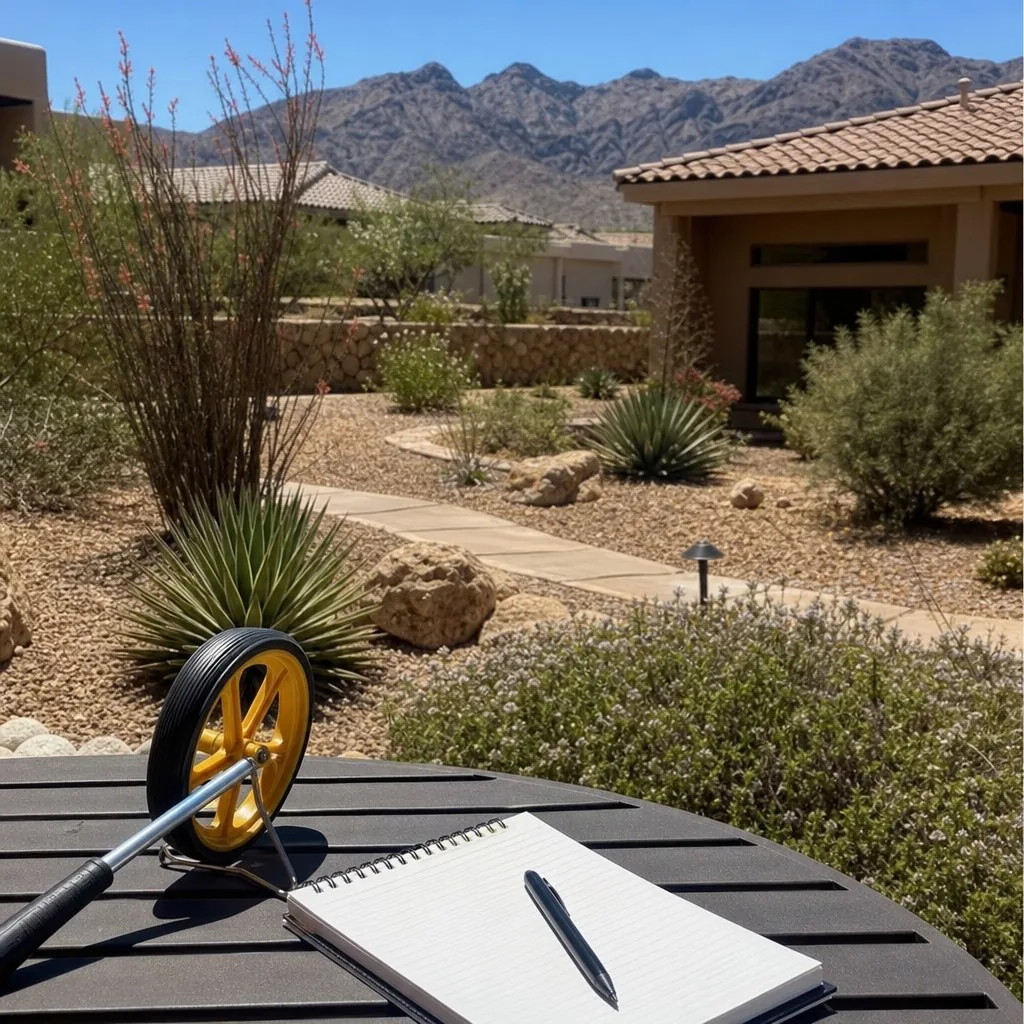
- Measure your irrigated turf area in square feet.
- Convert: area × inches ÷ 12 ÷ 100 = CCF per application.
- Stack irrigation on your normal usage and price each CCF at the tier it lands in — not at the $3.92 base rate.
Define the boundary for helpful landscape guide in Watering Decisions
These are water volume charges only. The minimum monthly charge applies whether you irrigate or not, and wastewater and other charges are billed separately and on a different basis. Rates change; the figures above are from the schedule effective with meter readings taken after March 1, 2026, and should be checked against the current schedule before relying on them. Nothing on this page is a service quote.
Frequently asked questions
What are El Paso Water’s residential water rates? A minimum monthly charge of $11.82 for a meter under 1", including a 5 CCF allowance, then $3.92 per CCF up to 150% of AWC, $9.26 per CCF from 150% to 250% of AWC, and $13.24 per CCF above 250% of AWC.
What is AWC? Average Winter Consumption — the average amount of water used during your most recent December, January and February billing periods. It sets the boundaries of your rate tiers.
Why is my summer water bill so high in El Paso? Irrigation stacks on top of normal household use and pushes you past 150% and then 250% of your AWC, where water costs $9.26 and then $13.24 per CCF instead of $3.92.
Does using less water in winter make summer watering more expensive? Structurally, yes. A lower AWC places your 150% and 250% boundaries at lower volumes, so irrigation reaches the higher tiers sooner. On the assumptions on this page, the same 5,000 sq ft lawn costs about $35 more per month at an AWC of 6 than at an AWC of 10.
How much does it cost to water a 5,000 sq ft lawn in El Paso? On these assumptions, roughly $184.59 a month at an AWC of 6 CCF, or about $150.03 at an AWC of 10 CCF, in volume charges.
How much water is one inch over 1,000 square feet? 0.8333 CCF, which is 83.33 cubic feet.
What does a leak cost? Leaked water is billed at your highest active tier — up to $13.24 per CCF. The ordinance also prohibits failure to repair a leak within five working days of discovering it.
Sources
- El Paso Water — residential rates and fees (minimum charge and volume allowance, AWC-based tier structure, per-CCF rates effective with meter readings taken after March 1, 2026): epwater.org/residential/billing-and-rates/rates-and-fees
- El Paso Water — residential watering schedule and Water Conservation Ordinance (three watering days a week, designated days, the five-working-day leak provision): epwater.org/residential/conservation/watering-schedule
Method note: all costs here are arithmetic applied to the published tariff above. The one-inch-per-week depth and the AWC values of 6 and 10 CCF are stated assumptions, shown so they can be replaced with your own figures.
Audit irrigation delivery around the El Paso address schedule
Get a Free Quote
Tell us which El Paso yard condition or outdoor use needs attention.
Frequently Asked Questions
What should an El Paso lawn-water cost review walkthrough trace before materials are chosen?
Trace where water enters, where it runs and where it collects; then note reflected heat, shade, irrigation reach and equipment access. Those observations define the working limits for lawn-water cost review without pretending an unseen area has already been diagnosed.
How are heat and runoff handled in El Paso lawn-water cost review planning?
Heat exposure and runoff are recorded by zone, not averaged across the yard. The plan can then place preparation, materials and irrigation decisions beside the condition they answer, leaving unrelated areas outside the scope.
What remains undecided until an El Paso property is inspected?
Subsurface condition, usable irrigation pressure, drainage direction and access constraints should stay unresolved until they are checked on site. A responsible lawn-water cost review proposal labels those unknowns and explains how each could affect the work.