Hardscaping in El Paso covers patios, walkways, retaining walls, borders and gravel surfaces built to survive caliche, summer cloudbursts and 100 degree afternoons. Pavers typically run $10 to $17 per square foot, flagstone $15 to $27, and block walls $20 to $55 of wall face. Call for a site visit and a line-item quote.
Call (915) 465-9148 or get a free quote.
What counts as hardscaping for an El Paso yard?
Hardscaping is everything in the yard that is not alive: patios, walkways, driveway borders, steps, retaining walls, seat walls, fire pit pads, planters and edging. In a desert lot it also includes the gravel and rock surfaces that replace lawn, since they need the same base preparation.
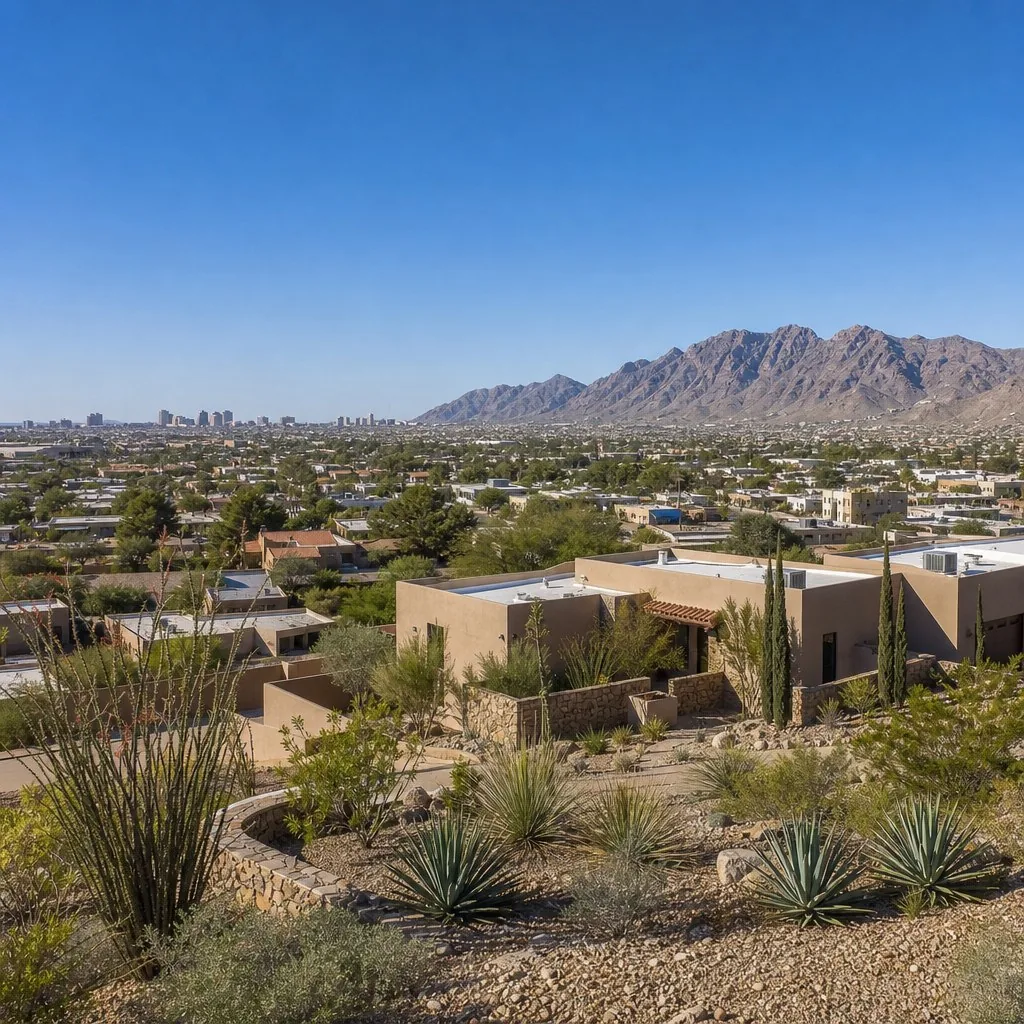
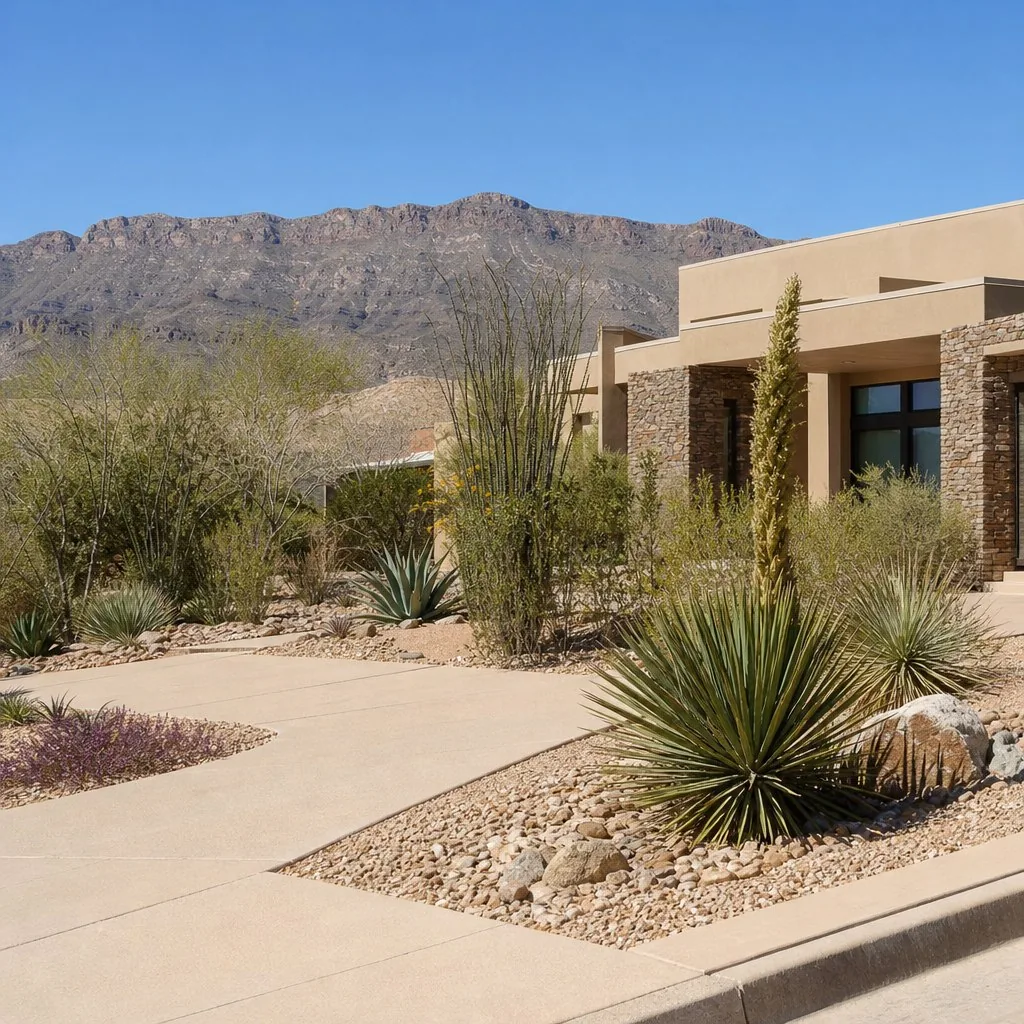
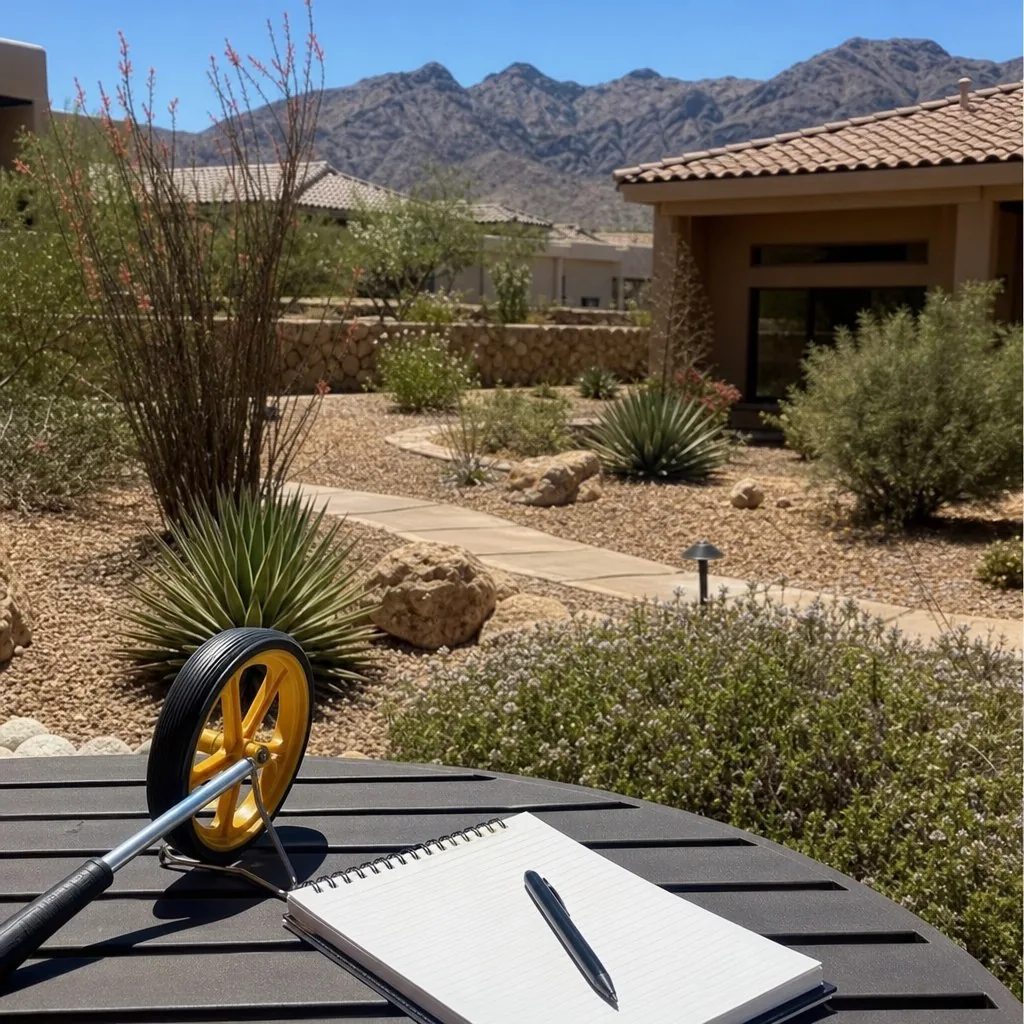
The reason people hire this work out is not the stone. It is the ground underneath. A patio is mostly an excavation and a compacted base with a thin surface on top, and in El Paso the excavation is where the surprises live.
Surfaces
Concrete pavers, natural flagstone, stamped or poured concrete, brick, crushed rock and decomposed granite all work here, each with a different heat, drainage and cost profile. Which one fits depends on how the space is used, how much foot traffic it takes, and how much water you want it to shed.
Structures
Retaining walls, seat walls, raised planters and low screen walls hold ground or define space. These are the items most likely to trigger a permit or need drainage behind them, so they get the most planning attention.
Edges and transitions
Steel, concrete or stone edging keeps gravel from migrating into beds and holds paver fields from spreading. It is cheap compared with the surface it protects, and it is the detail that separates a yard that looks fresh in year five from one that looks like it dissolved.
How much does hardscaping cost in El Paso?
Published 2026 installed ranges put concrete pavers at $8 to $16 per square foot, flagstone at $15 to $27, poured concrete at $5 to $15, and retaining walls at $20 to $55 per square foot of wall face for concrete types. Your quote moves with caliche, slope, access and edge details.
The table below collects the ranges we use to frame a project. They come from published 2026 cost surveys, so treat them as a starting band and expect the site visit to move your number.
| Element | Typical installed range | What moves it |
|---|---|---|
| Concrete paver patio | $10 to $17 per sq ft | Base depth, pattern, edge restraint |
| Flagstone, dry-laid | $15 to $27 per sq ft | Stone thickness, joint fill, fit |
| Poured concrete slab | $5 to $15 per sq ft | Finish, color, control joints |
| Retaining wall, concrete types | $20 to $55 per sq ft of face | Height, drainage, footing, reinforcement |
| Decorative rock or DG ground cover | Part of the $4 to $8 per sq ft basic conversion band | Depth, fabric, edging |
Labor typically accounts for $6 to $11 per square foot of a paver job and $11 to $15 of a flagstone job, with the rest in material. Retaining walls add drainage and, for taller walls, reinforcement, which can run about $1.50 to $2.50 per square foot for rebar and $2 to $10 for waterproofing.
For El Paso-specific context, a published 2026 local xeriscape price list bands whole-yard work at $4 to $8, $8 to $15 and $15 to $30 or more per square foot, the top band being the one that includes pavers, seating and lighting. Our pricing guide covers what separates a low quote from a realistic one.
Which materials work best in El Paso heat?
Light colored concrete pavers, natural flagstone in lighter tones, and permeable surfaces such as decomposed granite handle the heat best. Dark surfaces store and radiate heat late into the evening. Match the material to the use: bare feet and pets favor lighter, rougher, cooler-to-the-touch surfaces over dark and glossy ones.
Concrete pavers
Interlocking pavers tolerate small ground movement because the joints flex, and a damaged unit can be pulled and replaced. They suit patios and driveways. Their performance depends almost entirely on the base, which is why base depth belongs on the quote as its own line.
Flagstone
Natural flagstone gives an irregular, desert-appropriate look and takes heat reasonably well in lighter tones. Dry-laid on compacted base, it costs less and drains through the joints. Mortar-set or concrete-set versions run higher, with published figures reaching $42 to $45 per square foot for the concrete-set method.
Poured and stamped concrete
Poured concrete is the least expensive hard surface, and stamped or colored finishes add pattern. Slabs crack where caliche, fill and moisture move, so control joints and thickness matter. Concrete also sheds water rather than absorbing it, which is a drainage consideration, not just a cost one.
Decomposed granite and crushed rock
These are the budget surfaces for paths, seating areas and whole-yard ground cover. They stay permeable, so monsoon water soaks in. Laid over fabric with steel edging, they hold up well. Laid thin with no edging, they migrate and the weeds return within a season.
Why does caliche matter so much for patios and walls?
Caliche is a cemented calcium carbonate layer found under much of El Paso. It is hard to excavate and nearly waterproof, so it affects footing depth, drainage and cost. A paver base needs to shed water rather than pool on top of it, and walls need weep paths that do not dead-end into it.
Caliche cuts both ways. A solid layer can be a stable base for a slab or a wall footing. A fractured or inconsistent layer can settle unevenly. Either way you want to know where it is before the design is final. Texas A&M AgriLife Extension El Paso County recommends breaking through hardpan for planting holes, and the same logic applies to drain lines. See our soil and site guide for what to check on your own lot.
Monsoon runoff
Over half of El Paso’s roughly nine inches of annual rain arrives in summer, much of it in short, hard cells. A hard surface sheds all of it at once. That is why patios are sloped away from the house, why walls get drainage stone behind them, and why a swale or basin often appears on a hardscape plan next to the surface it protects.
Freeze and expansion
Winter nights drop below freezing, and the caliche and clay-bearing pockets move a little. Rigid, unjointed surfaces crack. Flexible joints, control cuts and a compacted, free-draining base are the defense, and they are most of what a hardscape quote pays for.
Do I need a permit for a patio, wall or fence in El Paso?
Sometimes. In the City of El Paso, retaining walls, fences, and elevated or attached patios and decks can need a building permit depending on height and load, so confirm the exact thresholds with the City before you build. Ground-level patios generally do not.
Permit questions go to the City’s Planning and Inspections Department, and applications run through its online Citizen Access Portal. Outside city limits, check with the municipality or with El Paso County, since Socorro, Horizon City and San Elizario each run their own local rules. Our permits and project planning guide lists the questions to bring.
Two rules apply regardless of permits. Texas law requires a call to Texas811 at least two business days before digging, and utility owners mark their lines for free. And any HOA with design covenants may need to approve walls, materials or colors before work starts, which can add weeks.
If a wall needs engineered drawings, the permit office decides what it wants to see, so ask early rather than after the quote is signed.
How does a hardscape project work from first call to final walkthrough?
It moves from a conversation and site visit to a dimensioned layout, a line-item quote, utility marking, construction, and a final walkthrough. You approve at each step, and the permit question gets answered before any material is ordered, so nothing is built that the City would later ask you to remove.
- Call and scope. You tell us what you want to build, who uses it, and the budget range. We ask about slope, gates, pets, existing irrigation and HOA rules. The conversation usually takes 20 to 30 minutes.
- Site visit and probing. We measure the area, mark the fall, locate hose bibs and drains, and probe for caliche depth where the surface or footing will sit. This visit is what turns a ballpark into a real number.
- Layout and material choice. You see the outline marked on a drawing with surface choices, edge details and drainage direction. Samples and tone choices are decided here, not on the day material arrives.
- Quote and permit check. Each element gets its own line: excavation, base, surface, edge, drainage and haul-off. If a wall or elevated structure triggers a City permit, the application path is flagged before you sign.
- Utility marking and scheduling. The Texas811 request goes in at least two business days before digging. Start dates also take into account material lead times and, for any attached planting, the watering window.
- Construction. The sequence runs excavation, base placement and compaction, drainage, surface, edge restraint, joint fill, cleanup. A patio of a few hundred square feet is typically a matter of days, while walls and larger fields take longer.
- Walkthrough. Together you check slopes with water, look at joints and edges, and agree on care: sweeping, joint sand top-up, and what to watch for after the first monsoon.
Example scopes: typical El Paso hardscape projects
These are typical projects built from the published ranges above, not accounts of finished jobs. They show how the arithmetic works.
Example scope: 320 square foot paver patio on a gently sloped lot
A typical lot for this has a backyard falling a few inches toward the house and a bare lawn area off the back door. The scope: excavate roughly eight inches, correct the slope so water runs away from the foundation, place and compact a base, set pavers with steel or concrete edge restraint, sweep in joint sand, and tie a roof downspout into a gravel basin.
At $10 to $17 per square foot the patio comes to $3,200 to $5,440. The complication is caliche in the excavation, which affects the hours rather than the surface price and is confirmed during the site probe. The slope correction is the item that keeps the patio from becoming a pond.
Example scope: 40 foot block retaining wall, 3 feet tall
For a lot like this, a Northeast backyard sits on a slope with a lower terrace for planting. The scope is a 40 foot wall holding about 3 feet of grade, with a compacted base, drainage stone and perforated pipe behind it, a cap course and a small return at each end. Wall face is 120 square feet.
At $20 to $55 per square foot of face the wall costs $2,400 to $6,600. A wall at this height falls under the 4 foot permit threshold, provided it carries no extra load. Raise it to 5 feet or park a driveway above it, and the permit conversation starts.
Example scope: 200 square foot flagstone seating area, dry-laid
This is a typical side-yard or front-courtyard project: remove old grass or gravel, excavate, place a compacted base, set irregular flagstone with fine gravel or decomposed granite in the joints, and add steel edging along the planting side. At $15 to $27 per square foot, 200 square feet comes to $3,000 to $5,400.
The local complication is thermal. Thin, dark stone in full afternoon sun gets hot enough to be uncomfortable barefoot. Choosing lighter stone or placing a shade structure or tree on the southwest side changes how the space gets used in June.
What drives a hardscape quote up or down?
Site access, excavation difficulty, drainage needs and surface choice move the price most. A gravel path across open ground costs a fraction of a paver patio against a slope. Anything buried, such as drains, footings and base, costs money that is invisible once the surface is down.
- Excavation. Caliche and rocky ground slow digging. Foothill lots can include rock that has to be broken or hauled.
- Access. Narrow gates or no equipment path mean hand work and higher labor.
- Height and load. Taller walls need deeper footings, reinforcement and sometimes engineering. Walls that carry a surcharge cost more still.
- Pattern and cuts. Curves, diagonals and inlays raise cutting time and waste.
- Demolition. Removing an old slab or failed wall and hauling it away adds cost. Our yard cleanup service covers haul-off for debris.
- Drainage. A catch basin, French drain or downspout tie-in adds a line, and it is usually the line that protects everything else.
How long does a hardscape surface last in El Paso?
A well-based paver or flagstone surface can last decades, while the base is what decides it. Edges, joint sand and drainage take occasional attention. Surfaces fail early when the base was shallow, water pooled, or edge restraint was skipped. Concrete lasts as long as its joints and thickness allow.
Maintenance is light but real. Sweep out debris, top up joint sand every year or two, and check edges after heavy rain. Gravel areas need topping up where traffic thins them. Pull windblown weeds before they seed and the area stays clean without chemicals.
What should a hardscape quote list line by line?
A useful quote itemizes excavation, base material and depth, the surface, edge restraint, drainage, demolition and haul-off, and cleanup. When those lines are missing, two quotes that look similar can differ by thousands of dollars, and the difference is usually buried in a base nobody can see afterward.
Ask for base depth in inches and the type of rock used. Ask whether the price assumes normal soil or covers caliche breaking. Ask where the water goes. A quote that answers those three questions in writing is easier to compare, and easier to hold to when the ground turns out harder than expected.
When is the best season to build hardscape in El Paso?
Fall through spring is the comfortable window, though hardscape is less season-sensitive than planting. Excavation, base work and setting pavers can run through summer if the work starts early in the day. Concrete needs attention to heat, since fast curing in July can crack a slab without proper curing and joints.
Monsoon season, roughly July through September, brings sudden storms that can wash out a prepared base overnight. Many owners schedule patios and walls for October through March, when storms are rare and a compacted base stays put until the surface goes on.
Can hardscape and irrigation share a plan?
Yes, and they should. Sleeves for irrigation lines belong under a patio or walkway before the surface goes down, because trenching later means cutting finished work. Planning the sleeve, the drain and the footing together saves money and avoids a broken surface.
If beds will border the hardscape, the plan should show where drip lines cross edges, which zones serve those beds, and where valve boxes sit. Drip irrigation handles the watering side. Where turf borders a patio, the artificial turf page describes how that edge is handled.
Texas requires a TCEQ licensed irrigator for irrigation system work done for others, so anyone proposing to install or alter zones should be able to show that license.
What does hardscape look like around a desert planting scheme?
Good desert hardscape sets up the planting. Terraces create planting shelves on slopes, curbs and borders hold rock in place, and a patio gives the eye a place to rest. Our desert landscaping work uses these elements to turn a gravel yard into something designed.
The common failure is a flat field of rock with a few plants. It reflects heat back at the house and looks unfinished. Breaking the surface with terraces, a seat wall, a shaded patio and layered planting makes the same square footage feel intended and keeps it cooler.
Where we build: neighborhoods and valley towns
Hardscape needs change from one part of the metro to the next. On the slopes around West El Paso and Northeast El Paso, retaining walls and terraces do most of the work. In East El Paso, flatter lots favor patios, paths and drainage correction.
Out along the valley, the Lower Valley and Socorro have older irrigated lots where patios and borders sit near mature trees whose roots limit digging. Each area has different permitting contacts, so we check the right office for your address before pricing a wall or elevated structure.
Plan your hardscape
Send us the dimensions, a few photos and what you want the space to do. Call (915) 465-9148 or use the free quote form to set up a site visit and get a line-item number.